
Today’s chief financial officer (CFO) is vastly different from their decades-ago counterpart. Whereas the latter CFO focused on accurate financial statements and the bottom line, today’s CFO is being tasked to embrace a more strategic focus.
That means contemporary CFOs need a wider range of skills—both personal and professional—that are far beyond an elevated accountant’s role. CFOs need to be leaders, financial gurus, employee developers, and ‘board savvy’ presenters of complicated information to better enable the board of directors to have a sophisticated and future focused strategic conversation. CFOs also must establish strong cross-functional relationships, compelling peers to better understand the significance of their roles and impact on the organization’s financial and operational performance.
Preparing for an uncertain future
The future is arguably more difficult to predict today. However, we do know the landscape is changing. CEOs are transitioning out at an accelerated pace with increased retirements industry-wide and Millennials now comprise a majority of the workforce. AI is already impacting the way many people work and continues to evolve rapidly.
With the typical CFO role and its most common occupant, it’s important to understand their primary technical skills, mode of communication, measure of success and behavioral approach to problems and challenges.
As the chart below demonstrates, personal mastery competencies between CFOs and CEOs vary in a number of key areas. As forward-looking CFOs prepare for the future, new skills must be honed.
Personal mastery competencies
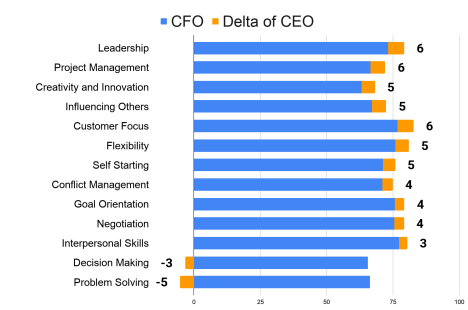
The purpose of finance roles and their occupants must change. We cannot rely on the historic feeding pools and training grounds to produce different results.
Evolving roles, acquiring skills, defining success
The context of the CFO role must evolve to add more and different strategic value. Today’s CFOs must answer the following key questions: What is that value? How do I gain those skills? What does success look like?
In the future, we believe CFOs will add strategic value by:
- Building consultative partnerships
- Deconstructing complex problems
- Raising talent’s financial acumen
- Championing sustainable solutions
Building consultative partnerships
By definition, a consultative partnership is a partnership that is based on the services you provide to your business partners. It requires understanding their needs (both explicit and underlying), identifying with their perspective, counseling, advising and building templates. It also demands objectivity and is different from you providing reports or red-lining their budgets.
For CFOs to acquire the skills needed to build such partnerships, they must start by living in their business partners’ worlds to truly understand their viewpoints. Other keys for successful partnerships include:
- Being decisive (good enough)
- Drafting their business cases
- Asking for rigorous feedback
- Empathizing
When successful, CFOs become a constitutive part of their partners’ brainstorming and planning sessions, making their lives easier and measuring success by qualitative factors—not just the numbers.
Deconstructing complex problems
A problem isn’t just a problem. It’s also an opportunity, a challenge, a need. When viewed this way, CFOs can look beyond the immediate issue and take a systems approach.
Leaders start by comprehensively outlining the situation, identifying key-interactive components, and becoming intimately aware of those variables' intended outcomes and unintended consequences.
To acquire such skills, CFOs must do “Deep Work” (Cal Newport), extracting and reviewing atypical data with others, and conducting holistic research to forecast future intended and unintended outcomes.
Success is defined by framing domain-level data in a digestible manner. It requires extreme amounts of patience and focus along with the delegation of routine financial tasks.
Raising talent’s financial acumen
When we say talent, we mean staff, management, board, and peer executives. Forward looking CFOs are charged with equipping talent with the financial acumen, depth of perception, and understanding to make them more (financially) dangerous practitioners.
The base level of financial acumen present directly enables/inhibits the sophistication of strategic dialogue. Said differently, it is very challenging to have a strategic conversation for a balance-sheet based business when not everyone understands the organization's economic engine.
CFOs should focus on visuals, not tables, develop and refine curriculum, teach, teach, teach, and test to measure progress.
Success includes empathizing that financials are not everyone’s bag, getting to the point where non-finance leaders teach others (beginner to advanced), and talent meaningfully incorporating financial variables into discussions and plans.
Championing sustainable solutions
“Ignoring the basics is a great idea,” said no one. ever.
Championing sustainable solutions means identifying, enabling, and ushering the organization to deliver fully vetted and refined core competencies that strengthen and reinforce competitive advantages.
CFOs should create an operational cushion and clarity for the good, bad, and ugly times. They can acquire such skills by cultivating an engaging presence, producing less documented recommendations, and sharing less passive comments that are interpreted as “I told you so.”
By facing directly into blind spots and understanding intangible and immeasurable value, leaders can champion more sustainable solutions.
Success is defined as co-selling/presenting well-thought-out and holistic visions (without #s), regularly eliciting and securing buy-in/support, embracing change (course, opinions) smoothly.
The future CFO role, in many ways, is already here. It’s imperative for today’s leaders to begin adding strategic value by:
- Building consultative partnerships
- Deconstructing complex problems
- Raising talent’s financial acumen
- Championing sustainable solutions
Want to discuss the evolution of your role or how to find the right talent to lead your institution in the future? Contact DDJ Myers' experienced team to learn how we help individuals and organizations advance leadership.