Most credit unions are working harder than ever for growth that gets more expensive every year. Member acquisition costs have reached an all-time high near $565. Marketing budgets keep climbing. The number of federally insured credit unions has fallen from roughly 20,000 to about 4,287. When the math gets harder, the instinct is to widen the net and market to more people.
The data points to the opposite move. The credit unions outgrowing their peers are not casting wider. They are choosing who they serve, building around that choice, and refusing to apologize for who they are not for.
Growth has stalled, but not because of awareness
Three in four U.S. consumers hold a positive view of credit unions. Only one in twenty hold a negative one. Yet just one in four actually banks primarily with a credit union. The rest go to national banks, regionals, and fintechs. Those figures come from our 2026 Consumer Perception Report, and the gap they describe is the whole problem.
It is not a perception problem. People already like credit unions. What they do not have is a clear sense of whether they qualify, whether the technology will meet their expectations, or whether a credit union is meant for someone like them. Eligibility confusion ranks among the top reasons consumers give for not switching. It is also the one barrier on that list that costs almost nothing to fix. No new branches. No new app. Just clarity.
The growth problem is a fit, friction, and focus problem. Those are three things a credit union can actually change.
Start with the member, not the product
Most credit unions plan growth by starting with the products on the shelf and asking who might want them. The growing ones reverse the order. They ask who they serve uniquely well, find the overlap between member benefit and institutional profitability, and then build field of membership, branching, and marketing around that segment.
A member belongs in the strategy only when two things are true at the same time. The member has to be profitable to the credit union, with a workable account mix and reasonable cost to acquire and serve. And the credit union has to be genuinely better for the member, saving them on rates and fees or opening access to credit they would not otherwise get. Profitable but unhelped erodes the mission. Helpful but unprofitable erodes capital. The intersection of the two is the strategy.
Let the data tell you who and where
Once the ideal member is defined, the next questions are how many of them exist and where they are concentrated. Sizing the market is not a discipline exercise. It is a diagnostic. A narrow addressable market caps growth and raises its cost, and a credit union already serving a large share of the people its charter reaches has a ceiling problem that no marketing budget will fix.
Finding where those members cluster takes more than instinct. It takes demographic concentration data, predictive performance models by market, an honest read on where banks and fintechs are already winning, and a clear view of what the current charter actually allows. At a cost near $565 to acquire a single member, targeting is not optional. The price of marketing to the wrong people is now high enough that precision is the only way the math works.
Field of membership is the mechanism, not the paperwork
Field of membership is what converts a growth strategy into eligibility. It is also where the funnel quietly breaks. A large share of abandoned membership applications drop off at the eligibility step, and a significant portion of consumers do not believe they are eligible to join a single credit union. None of that is a product or a pricing failure. It is a charter and communication problem. Structure sets the ceiling on who a credit union can reach.
Federal community charters let a credit union serve everyone who lives, works, worships, or attends school in a defined area. They are strong for community-based outreach, but they carry geographic ceilings that can stall growth over time.
State charters operate under individual state rules, which vary widely. Some offer more flexibility or other advantages than the federal options, at the cost of coordinating across state lines.
The federal multiple common bond charter is the most flexible structure. It lets a credit union serve multiple employee groups, associations, and underserved areas at once. As credit unions reach scale, it supports diversification, reduces concentration risk, and leaves room to shift strategy as priorities and markets change.
The point is not to chase the biggest possible field of membership. It is to match the structure to the goal. One $227 million Louisiana credit union converted from a community charter to a multiple common bond charter and added a nationwide association in a single effort. Its potential field of membership grew from 385,000 to 1.6 million, but the real win was alignment: it could keep serving its existing community more inclusively while opening a defined, national path to the members it was built to serve.
Then spend where it actually compounds
Once the ideal member is defined, sized, located, and eligible, marketing spend becomes the highest-return lever a credit union has. Decades of industry data show that a dollar spent on marketing produces far more asset growth than the same dollar spent improving deposit rates. It is the most reliably proven growth driver in the record.
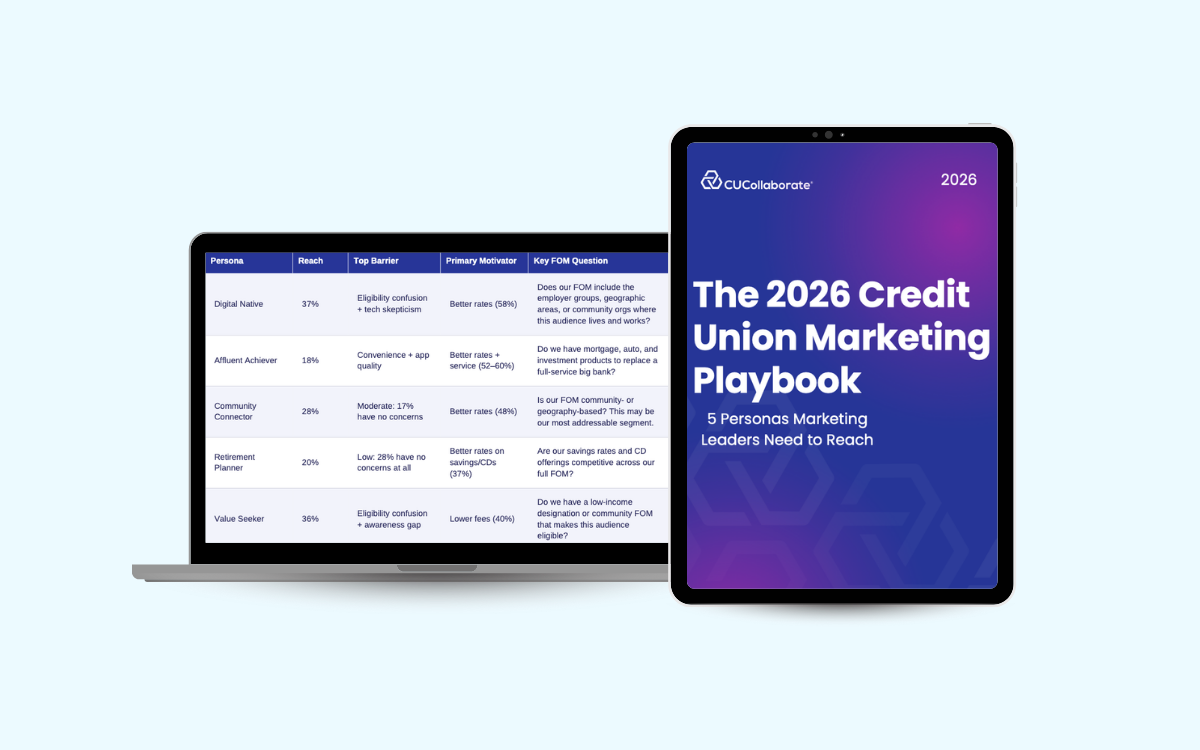
The discipline is not to chase every segment at once. Pick the persona that fits the field of membership best, build one campaign with a clear rate or fee comparison, and measure the result. And remember what marketing is actually for. Its job is not to argue that credit unions are good. People already believe that. Its job is to correct the false assumptions about technology and convenience that quietly keep eligible people from joining.
Don't be everything to everyone
The credit unions that grow over the next decade will not be the ones trying to serve everyone. They will be the ones that picked a segment, built the field of membership around it, fixed the eligibility friction, and put their marketing where it compounds.
Growth requires access, and access starts with a question most growth plans skip. Not how do we add more members, but which members is this institution built to serve better than anyone else. Answer that first, and every step after it gets cheaper.
That question, and the framework for answering it, is what we are working through on The Credit Union Growth Playbook: How to Build Sustainable, Member-Driven Growth, a free session on Wednesday, August 12 at 2 p.m. ET. If your credit union is rethinking where its next decade of growth comes from, it is a good place to start.