
Have you seen the news? The Mortgage Bankers Association recently published a white paper warning that demographic changes—accelerating due to immigration policies—are likely to have profound implications for the housing market in the coming years.
MBA notes household formation is expected to slow over the next decade due to an aging population low fertility rates, smaller younger adult cohorts, and big reductions in immigration.
If true, there will be big impacts on credit union operations, earnings and overall growth.
Population growth rarely makes the front page. But it has a way of quietly shaping almost every important economic conversation: housing demand for sure—but also labor supply, consumer spending overall, tax receipts, entitlement programs, community development, and long-run business investment.
The broad story is pretty straightforward: the U.S. population is still growing, but the long-run pace of growth is slowing dramatically. CBO’s latest demographic outlook projects population growth averaging just 0.3% annually over the next decade and only 0.1% annually from 2037 to 2056. By 2056, CBO expects the population to stop growing, and then begin to shrink. That is not an immediate demographic crisis per se, but it does point to an economy in which population growth contributes much less to overall economic growth than it once did.
The drivers are equally straightforward. Fertility is low. The population is aging. Deaths are rising as a share of the population. CBO expects deaths to exceed births beginning in 2030, which means net immigration becomes the only source of population growth after that point. Without immigration, the population would begin shrinking much sooner.
That matters because population growth is one of the two basic building blocks of economic growth. The other is productivity. When population growth slows, the burden on productivity growth naturally increases.
Slower growth also affects labor supply, consumer demand, housing, and public finance. It makes hiring harder, reduces growth that comes simply from more households, and increases pressure on programs tied to an aging population.
AI’s impact could rub both ways.
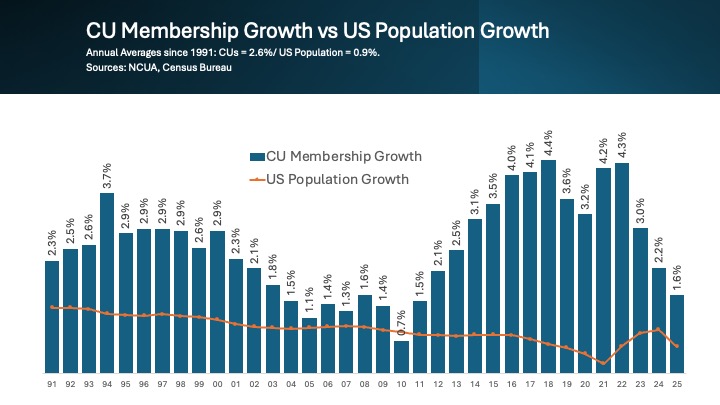
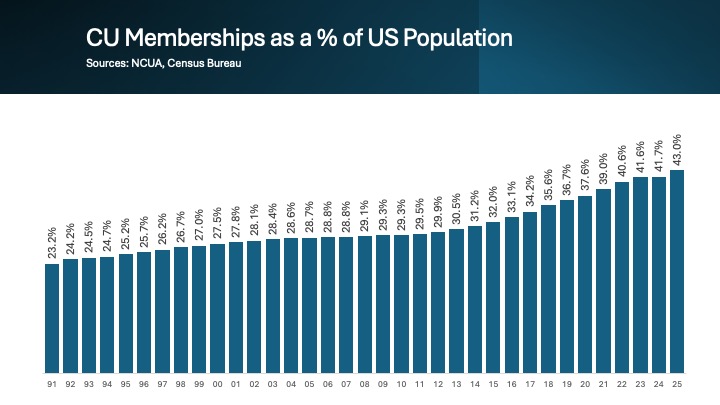
For credit unions, the population story is important. But it isn’t destiny. Credit union membership growth and U.S. population growth are related, but they are not the same thing. Population growth expands the potential market. Membership growth reflects the industry’s ability to attract, retain, and deepen relationships with consumers inside that market.
Recent data show the distinction. Aggregate credit union membership has continued to grow, but the typical credit union has been seeing modest membership declines. That tells us growth is concentrated. Larger institutions, faster-growing markets, stronger digital providers, and credit unions with broader fields of membership are generally better positioned to add members. Smaller institutions, single-sponsor credit unions, and credit unions in slow-growing communities often face tougher math.
There are several reasons credit union membership growth can differ from population growth. First is market penetration. Credit unions still serve only a portion of the population, which creates room to grow even in a slow-growth environment. Second is eligibility. Fields of membership have become broader and more flexible over time. Third is switching behavior. A household can join a credit union without being “new” to the economy. Much of the opportunity comes from winning relationships from banks, fintechs, and other providers—especially when consumers are frustrated with fees, pricing, or impersonal service.
That’s why the outlook for credit union membership growth may be more favorable than the outlook for U.S. population growth. Population growth is constrained by fertility, mortality, aging, and immigration. Membership growth is constrained by relevance, access, technology, pricing, service quality, brand awareness, and execution. Those are hard challenges, but they are more directly within the industry’s control.
The opportunity is especially clear among younger consumers, new Americans, lower- and moderate-income households, and members facing financial stress. It is also clear where credit unions can pair digital convenience with local knowledge. In a slower-growth economy, relationships become more valuable. Institutions that solve real problems—helping members buy homes, manage debt, build emergency savings, finance reliable transportation, or navigate income volatility—should be able to grow faster than the population around them.
Still, stronger membership growth is not automatic. The typical credit union membership trend is a warning. Demographics are not doing the industry any favors. Credit unions will need to earn growth by making membership easier, products more relevant, channels more convenient, and value more obvious. Institutions that do that well should outperform national population growth. Those that do not may find that a slow-growth environment exposes weaknesses that were easier to overlook when the economy and membership base were expanding more quickly.
In short, U.S. population growth is likely to slow, age, and experience less immigration (given current immigration policies).
That will weigh on the economy’s long-run growth potential and raise the premium on productivity. But credit union membership growth can still be stronger than population growth. Credit unions are not limited to waiting for new people to be born or arrive. They can grow by becoming more relevant to the people already here.
A strong focus on mission and an unwavering commitment to purpose—will be especially important in this evolving world.
In any case, I’m told our friends at the Filene Research Institute will be releasing a study on credit union growth in the not-too-distant future. It might be a good idea to be on the lookout for that!