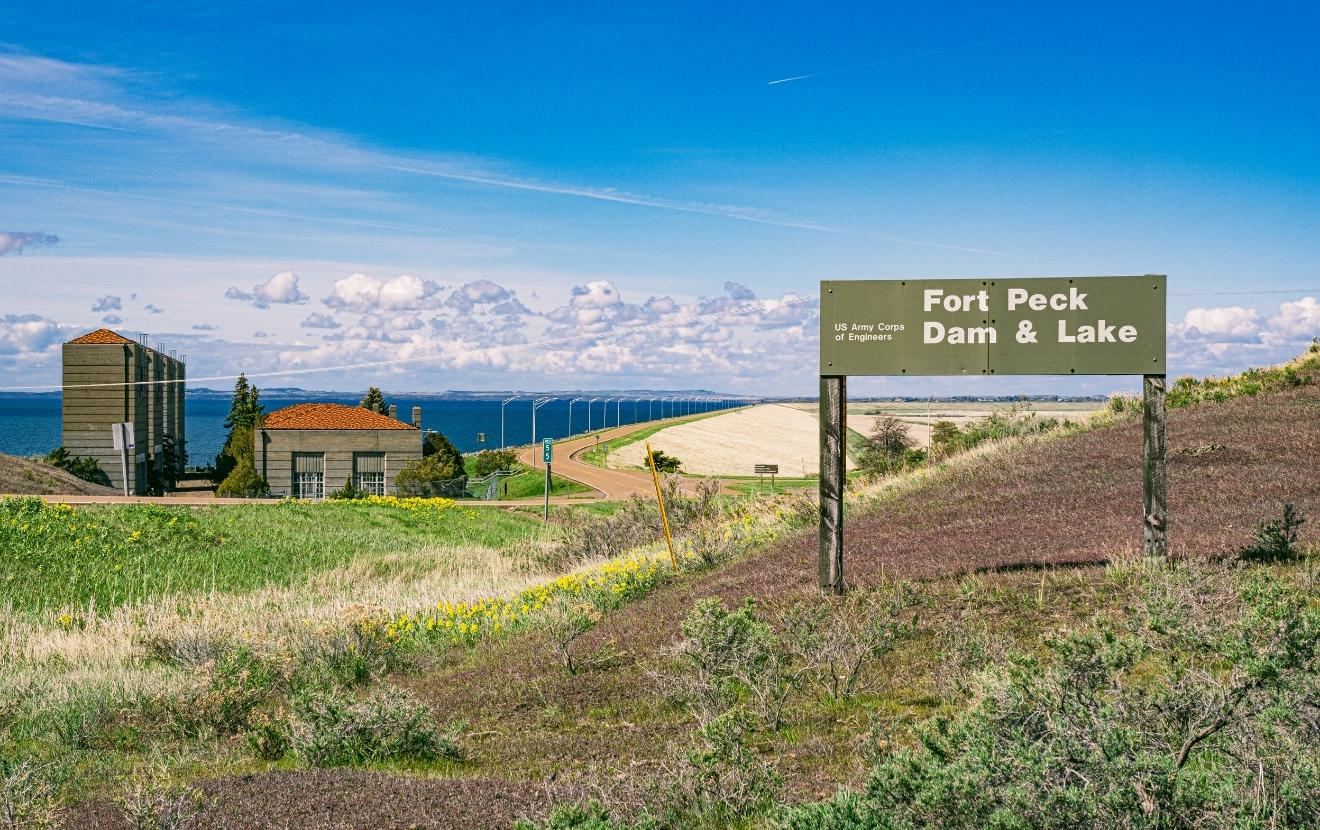
After finishing a strategic planning session with a credit union in northeastern Montana a few months ago, I made the decision to drive the long way back to my hotel, which was actually across the border in Williston, North Dakota.
Driving down Highway 13 through the Fort Peck Indian Reservation (before heading east towards Williston) my hope was to enjoy some cultural sightseeing and appreciation.
I’d only had the opportunity to see and visit a Native reservation once before in my life—in Arizona, visiting the family of a girl my mom had once mentored—and I didn’t want to miss the opportunity to learn more about the communities that I would like the credit union industry to better support.
Heading due south under a high, gray Montana afternoon sky, a directionally straight but hilly stretch of two-lane highway brought me through rolling hills and a patchwork of cattle ranches scattered across the rising plains.
As I drew closer to the Reservation, I was growing excited to see the first signs of the Native community I’d come searching for.
A vibrant history and culture
Before I get to my experience at the Reservation, I’d like to share some of the research I pulled together on the history of this area once I returned home, especially around the culture and the people.
The Fort Peck Reservation is actually home to two tribal nations, including the Assiniboine and the Sioux, and both tribes have roots in Montana, North Dakota, and Canada that date back centuries (at least the 1500s).
Like many other Plains Indian cultures, the Assiniboine and Sioux’s heritage centers deeply on the bison, which had been their primary source of food, clothing, shelter, and tools.
Elders in both tribes continue to speak and teach their Native dialects, and you can hear Native speakers using the language here.
Perhaps the cultural area I enjoy most though is the importance of art, dance, and songs in everyday life; customs that have persisted for centuries in the face of European “influence.” For example, today “star quilts” are artful expressions of this rich cultural heritage and are often used as gifts for momentous life events.
The star pattern (typically an eight-pointed star) symbolizes the morning star—which also, coincidentally, shares its namesake with a recently chartered credit union in Montana, The Morning Star FCU, focused on serving the Northern Cheyenne people.
My colleague at the Native American Credit Union Coalition (NACUC), Maria Valandra, who works for Clearwater Credit Union in Montana and provides mentorship and support for The Morning Star FCU, also tells me that the credit union was actually named after one of the Chiefs in the Tribe of Northern Cheyenne: “Morning Star,” also known as “Dull Knife.”
Morning Star was famous for leading the resistance against Western expansion by the United States.
As a symbol, the morning star still possesses profound spiritual and cultural significance in Native communities. It represents guidance, a connection to ancestors, and most saliently here, hope.
Arriving to town
As I mentioned previously, my family had visited the Gila River Indian Community outside of Phoenix when I was in my 20s, and while I wouldn’t describe that community as affluent, there were single-family homes, paved streets, and stores. My recollection is that it looked and felt like a peaceful, working-class suburb.
But the first community I came to on the Fort Peck Indian Reservation in Montana that gray day was quite different. There was a small stretch of Main Street with a few one-story buildings alongside it that were obviously deserted: Boarded up, broken windows, tagged with graffiti.
Past that grouping of buildings, I drove by a residential area. There were no apartment complexes or single-family houses; just mobile units and manufactured homes.
The people who were out and about looked a little aimless, or lost. Maybe even angry. And I think I understood why. Because in this tougher-looking community, I saw so much potential; potential for commercial activity, for neighborhood stores, and community events.
I saw places to gather, places to practice customs, to share traditions, art, and Native songs. It was all so possible. I was discouraged, yes. I saw the rough parts of the community, but I saw those beautiful parts too. There was real hope here.
Driving past the Reservation, reflecting on what I had seen from my rental car, I found myself hoping that this small slice of land wasn’t representative of the overall area.
But upon further investigation when I returned home, I found that conditions throughout the rest of the Fort Peck Reservation in Montana are, in fact, uniformly poor. The poverty rate in these communities, most of which are considered “Persistent Poverty Counties” by the U.S. government, reaches up to nearly 50%. The jobless rate is triple that of the national average, and in some places soars well over 50%.
Zooming out to the bigger picture of Native lands in the United States, the trends I witnessed in Montana are often similar to economic conditions across many tribal nations. Unemployment on reservations can range from 25% to 75%. The national poverty rate is three times the national average at more than 25% for Native Americans. And homeownership—one of the clearest paths to wealth creation in this country—is significantly lower for Native people than other groups.
The numbers aren’t great. But what I’ve learned working with the founding members of the NACUC is that focusing on the culture and the people you find in these communities is far more important. Conversations about tribal communities often begin and end with what’s lacking. But to understand Native nations today, you simply can’t ignore the strength: the power of community, cultural knowledge passed down for generations, coalitions of support building from within (look no further than Native-established credit unions like The Morning Star and Lakota FCU, and the hundreds of Native CDFIs across the United States).
Yes, economic statistics matter, but so do the stories of the artists, educators, and young business leaders who are still working to create a vibrant future for these tribal nations. When I reflect on Fort Peck, and consider the ways that the credit union movement can provide support, these are the stories that I choose to focus on.
How credit unions can lend their support
I work with credit unions who provide assistance to low-income areas every day. They spur local investment by offering down payment assistance programs to help low-income borrowers access mortgages. They increase the tax base by helping members find better paying work with affordable used-auto loans. They offer credit-builder loans, help members pay down high-interest debt from predatory lenders, and deliver financial education to help members understand how to manage their personal finances. It all makes a difference.
This is why I am so thrilled that the Native American Credit Union Coalition has come together to provide better resources for credit unions who serve, or could serve, Native people.
The group is also looking externally from the credit union industry to build a strong coalition of partners and resources that would collectively tackle the entrenched and fundamental issues facing tribal communities; something I think is critically important for making an impact.
With fuller participation from individual credit unions, Native credit union professionals, and the overall movement, I believe NACUC can catalyze a real shift for tribal communities towards embracing cooperative finance, which could be transformative for millions of Native Americans across the United States.
In my opinion, however, the most powerful part of NACUC’s mission is the call to “honor and preserve our rich cultural heritages” through this work; not to just provide resources for Native credit unions and Native credit union professionals—certainly not to dwell on the statistics—but importantly to provide support in a way that respects and celebrates the customs, cultures, and traditions of these distinct, ancient, and still relevant communities.
Native-led credit unions, housing cooperatives, language preservation initiatives, and sustainable economic development programs are just a few examples of tribal communities charting their own paths. These aren’t just responses to hardship; they are expressions of sovereignty, vision, and pride. Organizations like NACUC don’t just offer support; they walk alongside and amplify Native leadership.
Of course there is a lot of work to be done. And I hope that if your credit union already serves Native people across the United States—or has tribal lands or Reservations within your field of membership—that you’ll get involved in the formation and continuation of this group.
And if you can get involved, let the history, vibrancy, and resiliency of these communities guide your support.