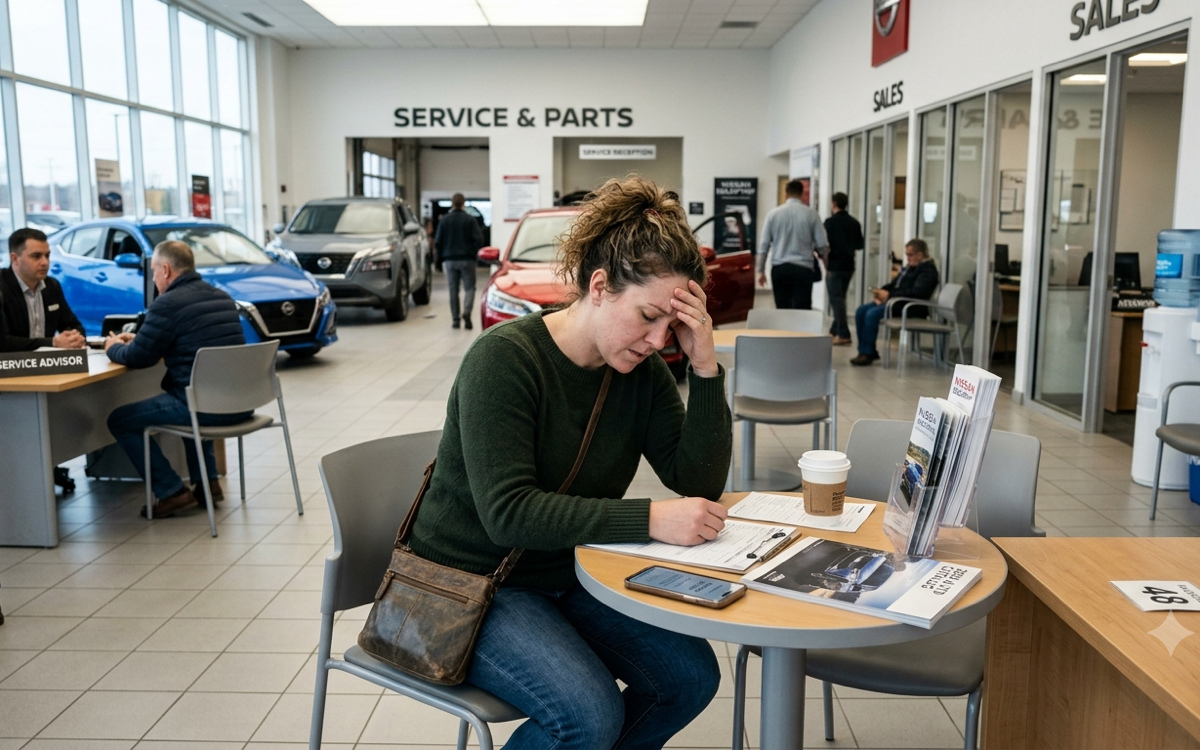
Think about the last time a member of yours bought a car.
She spent three weekends researching on one website and checking values on another. Then she drove to a dealership, where she spent four hours negotiating with someone whose job is to be better at negotiating than she is. Somewhere between the test drive and the signature, a finance manager ran her credit through a system that shopped her loan to a dozen lenders she had never heard of. One of them happened to be your credit union.
She didn’t choose you. She chose the car.
Three weeks later she got a letter, or maybe a text, from an institution she couldn’t name, telling her where to send money for the next seventy-two months. To make that payment, she created an account on a third-party portal that looks nothing like your brand. Her insurance lives in a different app. Her registration renewal comes from the DMV. When she wants to know what her car is worth, she goes back to the website where she started. When the check-engine light comes on, she starts from zero. And when she has a question about any of it, she calls a contact center where the hold music is the most consistent part of the experience.
This is the second-largest purchase most Americans will ever make. And it is held together with duct tape.
The system nobody built
Here is the uncomfortable part: no one designed this. There was never a meeting where someone decided the car-buying experience should be scattered across a dealership, a lender, an insurer, a payment portal, a valuation site, and a service department that don’t talk to each other.
It accreted. Each player optimized their own slice. Dealers optimized the sale. Lenders optimized underwriting. Insurers optimized the policy. Payment processors optimized the transaction. Every individual piece works, more or less. The whole is a mess, and the mess lands entirely on the person writing the checks.
Credit unions participate in this system because they have to. Indirect lending is how most credit union auto loans get made. The borrower is sitting in an F&I office, not a branch, and if you’re not on the dealer’s rate sheet, you’re not in the deal. Dealers participate because it’s how the industry has always worked. Consumers participate because they have no alternative.
Everyone is rational. Everyone is stuck. And everyone privately agrees the experience is terrible.
What being stuck costs you
For credit unions, the cost of this fragmentation is specific and measurable, and it hides in a word we use every day without flinching: indirect.
An indirect borrower is a member on paper and a stranger in practice. She joined your credit union in a back office she will never revisit. She makes payments through a portal you rent from a vendor. She will spend five or six years paying you every single month, a frequency of contact most marketers would kill for, and at the end of it she still couldn’t pick her lender out of a lineup. Industry veterans have joked for years that the only mail an indirect member ever opens from their lender is the payoff letter.
Then her next car purchase starts the whole cycle again, at a dealership, where the loan goes to whoever is on the rate sheet that day. Loyalty never had a chance to form, because nothing in the experience gave it a place to live.
The question worth asking
The fatalism is the part I would challenge. We treat the fragmentation of car ownership the way people once treated paper checks and branch-only banking: as a fact of nature rather than a set of decisions no one has bothered to revisit.
Look at what happened everywhere else in a member’s financial life. Payroll became direct deposit. Bill pay collapsed into one screen. Investing, budgeting, credit monitoring. Category by category, the fragmented experience lost to the unified one, and the institutions that owned the unified experience owned the relationship.
The car is the last big unconsolidated asset in a member’s financial life. It has a value that changes weekly, a loan, an insurance policy, a maintenance schedule, and an eventual sale or trade. Today those live in six different places, and none of them is the institution that financed the car.
Whoever brings them together first wins something bigger than convenience. They win the moment. The moment a member wonders what her car is worth. The moment her equity turns positive. The moment she starts thinking about the next car, which is the moment the next loan is actually decided, months before any dealer runs her credit.
Credit unions have a better claim to that position than anyone. They already hold the loan. They already have the trust. And they are the only player in the chain whose business model doesn’t depend on the member overpaying. That is why, at FinRank, we are building Rory: we start from the belief that the institution holding the auto loan should be the one place a member goes for everything about the car.
But the bigger point stands regardless of who builds it. The way we buy and own cars isn’t broken because it has to be. It’s broken because every player is waiting for someone else to fix it.
The waiting is the choice. It’s worth asking what it’s costing you.