
Inside credit unions across the country, the tension is real these days: there are more worthy initiatives than hours in the day, and leaders often feel perpetually behind. At a time when executive bandwidth is arguably at an all-time low, the challenge is not simply “doing more” but doing the right things—and enabling your teams to act decisively, efficiently, and with clarity.
Here’s a playbook of ideas and tactics credit union executives and senior teams can deploy now to keep projects moving, accelerate decision-making, and reduce friction.
The productivity imperative: Why bandwidth matters more than ever
Executive bandwidth is arguably the most precious and scarce resource in an organization.1
Each decision you delay or defer has an opportunity cost. In fast-moving environments (especially under competitive pressure from fintechs or agile peers), the cost of delay often outweighs the risk of an imperfect decision.
But leaders can’t stretch time. Instead, they must structure their work, their teams, and the decision pathways so that momentum is preserved even when capacity feels constrained.
Below are several principles and tactics, grounded in practice, that help.
Principle 1: Decide at 70%—don’t wait for 100%
One of the most powerful heuristics a leader can adopt is this: when you have ~70% of the information needed, make the decision. Waiting for perfect clarity too often becomes paralysis by analysis.
Why 70% works:
- In many cases, waiting for the last 20–30% of missing data produces only marginal improvements in decision quality.
- Delays introduce costs (lost opportunities, team demotivation, momentum stalls).
- Committing to a path often enables teams to begin implementation, which itself generates feedback and learning (i.e. adaptive correction is possible).
How to apply it:
- Define your threshold: Establish what “70%” means in your context: is it a certain number of data points, stakeholder inputs, or scenario analyses? Spell it out.
- Build in guardrails: Decide what kinds of decisions are low risk (okay to decide at 70%) vs. high stakes (maybe need extra input), and what course corrections are acceptable.
- Communicate the standard: Make it explicit to your leadership team and middle managers: “Unless something is truly mission-critical, we aim to make go/no-go calls at 70%.” This helps prevent endless debate.
- Use an “adjustment window": Even after decision, keep a short window early in execution where you watch for red flags and correct course as needed.
This approach doesn’t mean reckless decisions—it means recognizing that waiting too long is often the greater danger.
Principle 2: Reserve meetings for real decisions
Meetings are among the greatest drains on limited executive time. Yet many meetings accomplish little more than status reporting, agenda readouts, or debate without resolution.
A better filter: Only schedule a meeting when a decision must be made.
- Before you send the invite: Ask—What is the specific decision we must make in this meeting? If you can’t clearly articulate it, skip the meeting.
- Use alternate forms of communication: For updates or progress reports, use a shared dashboard, short memos, or asynchronous video messages instead of gathering everyone live.
- Empower autonomy: When teams know that only serious, high-leverage topics get meeting space, they will up their preparation, and they’ll be more selective about which problems rise to your level.
- Timebox discussions with decision-anchors: Start with “Here is the decision we are being asked to make,” then allocate time to debate, and conclude with a vote or agreement.
By creating a culture that reserves synchronous time only for critical decisions, you both protect your own bandwidth and force better clarity in preparation.
Principle 3: Use “Start/Stop/Continue” to focus improvement
To continually refine how your credit union operates—especially under pressure—a lightweight, recurring feedback framework helps prevent inefficiencies from creeping in. One of the simplest and most effective is Start/Stop/Continue (sometimes called Start-Stop-Sustain).
How it works:
- Start: What new practices, tools, or behaviors should we begin that align with our goals?
- Stop: Which existing practices or habits drain energy, waste time, or add little value?
- Continue: What works well and should be preserved or amplified?
How to use it in your credit union:
- At the end (or start) of each quarterly leadership meeting, invite each participant to propose 1–2 items in each of those three categories related to efficiency, communication, or process.
- Aggregate, cluster, and vote on the highest-impact items.
- Assign a small owner and timeline for the top 1–2 “Start” and “Stop” changes.
- Revisit in subsequent meetings: Did we follow through? Did it move the needle?
By giving structure to reflection, Start/Stop/Continue helps constant pruning of waste and reinforcement of what’s helping. In fast-paced environments, small continuous adjustments often outperform sweeping redesigns.
Principle 4: Uncomplicate your processes—trim, delegate, automate
The more moving parts a process has, the more friction, delays, and cascading inefficiencies. When bandwidth is low, the need to simplify is nonnegotiable.
Four practical levers to get started:
- Map the process: Even informal mapping can reveal redundant steps, handoffs, or approvals that add delay.
- Eliminate or delegate low-value tasks: Ask—Does this step directly contribute to our strategic goals, risk mitigation, or member value? If not, stop doing it or hand it off.
- Automate the low-hanging fruit: You don’t need a giant IT budget to start automating:
- Use workflow tools or low-code platforms (e.g. Microsoft Power Automate, Zapier, internal credit union systems) for routine handoffs.
- Automate calendar scheduling (e.g. via shared smart calendars or booking links) rather than back-and-forth email threads.
- Use templated documents and auto-population of forms.
- Automate notification reminders, escalations, or status flags in your project management tool.
- Invest early, not later—The irony is that when you think “I’ll automate when we have budget,” you never quite get to it because the delay itself becomes “normal.” Instead, treat a modest automation project as a priority—the returns will often pay for themselves by freeing staff hours.
Over time, process simplification compounds: fewer handoffs and less lag mean faster cycle times, fewer errors, and fewer escalations to executives.
Principle 5: Strengthen communication cascades & role clarity
Even the best automation and decision heuristics flounder without clarity and alignment in communications and roles.
- Cascading objectives and alignment: Ensure that every department, team, and individual has a line-of-sight to the top 2–3 strategic priorities. This cuts down misalignment and wasted effort. Research suggests that clarity in goals and alignment can boost performance by up to ~22%.
- Document decision rights: What decisions stay with you, and which are delegated? Make explicit the thresholds (financial, risk, strategic) for escalation.
- Use highlight reporting (not detailed reporting): Ask your teams for a short “red/yellow/green” summary or one-page dashboard; drill in only when something is off.
- Weekly “pulse” touchpoints: A short (10–15 minute) check-in with senior direct reports to surface barriers. Don’t use this as a catch-all meeting; focus on roadblocks needing escalation.
- “No surprises” principle: Encourage direct reports to flag issues early rather than waiting; anticipate that surprises upstream are too late to fix.
When communication is crisp and expectations are clear, you minimize idle time, redundant work, and misdirection.
A sample “efficiency sprint” roadmap for a credit union leadership team
Here’s how you might kick-start a 6- to 8-week “efficiency sprint” with your leadership team:
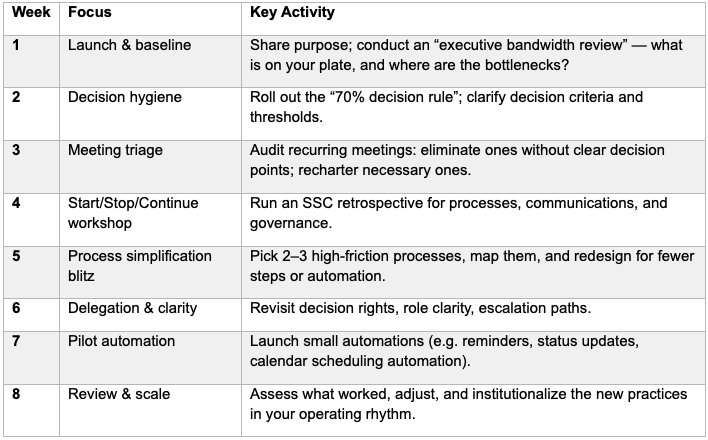
This kind of focused sprint creates momentum and builds confidence that “we can do things better, faster, with less overhead.”
The bottom line
In an environment where we face rising expectations and limited capacity, the organizations that thrive won’t be those with the most ideas—but those that execute the best under constraints.
When you:
- Decide faster (at 70%)
- Reduce meetings
- Continuously refine what you Start, Stop, and Continue
- Simplify and automate wherever possible
…you create a culture where efficiency isn’t just a goal—it’s a natural outcome of how your team works.“Efficiency is no longer a nice-to-have—it’s a competitive advantage.”