
My 6-year-old son constantly peppers me with the most random questions
- What do kiwis (the animal) sound like?
- Has there ever been a hurricane in Washington State?
- Why do football refs wear black and white stripes?
- Why do I dream?
Most of the time I’m stumped and my response is “I don’t know, ask Google.” And he runs off to the Google Home in the kitchen to ask.
Recently, I marveled at how quickly he can get answers to all of his questions and realized that most of the time he doesn’t even have to type them into a browser. He simply speaks to Google and has the answer read back to him. This is a prime example of zero-click marketing in action.
Another example of this is whenever I watch a movie and type the movie name into a search engine to answer the question, “Who is that actress and what else has she been in?”
The best part is immediately finding answers in Google, through a knowledge panel or AI-generated result, right at the top of the results page, and then returning my attention to the movie within seconds.
These are just a few of the reasons why more than two-thirds of Google searches end without a click (SparkToro, 2021). Here’s another visual example of how search engine result pages (SERP) make it easier to find information without having to click into a website.
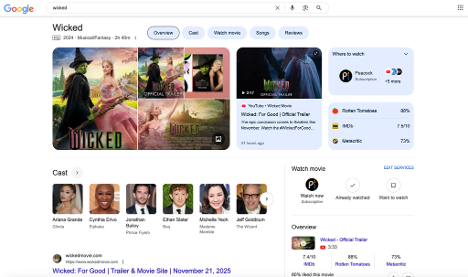
On the page, you see images, videos, quick info, a knowledge panel of the cast, where to watch the movie and critics’ scores. The first organic search result doesn’t appear until halfway down the page. Zero-clicks happen because Google wants to keep users on its platform by providing nearly all the answers upfront.
The rise of zero-click features
According to Ahref’s keyword explorer, 99% of keywords trigger at least one organic SERP feature. Here’s how Google is displaying results that keep you on their page:
- AI Overviews
- Knowledge card
- Knowledge panel
- People Also Ask
- People Also Search for
- Ads (appear at top and bottom of page)
- Featured Snippets
- Image Pack
- Local Pack (Map)
- Shopping results
- News / Top Stories
- Video Carousel
- Result Listings
And it’s not just Google. Social media platforms also encourage users to stay on their apps by limiting external links. TikTok and Instagram even offer in-app shopping, eliminating the need to click out to purchase items. For marketers, this makes tracking traffic from social platforms challenging.
The impact on marketing
With so many people finding answers without ever clicking to your website, it means that organic traffic metrics are likely skewed. Social media traffic is also hard to track accurately. The metrics we rely on to report ROI to stakeholders or senior leaders often fall short. What’s measurable isn’t always meaningful, and what’s meaningful isn’t always measurable.
This doesn’t mean SEO, social media and digital marketing are dead. Instead, marketers need to adapt.
Adapting to zero-click trends for your credit union
- Create meaningful, valuable content that your members actually care about. Then, reimagine it as a bite, snack, or meal to share across all platforms. Don’t be afraid to update and repost content to keep it relevant.
- Know your members better than anyone else. Understand your members deeply—where they are, what messages resonate, and how they want to engage with you.
- Build a solid foundation. SEO or social media alone won’t drive success. Create a cohesive digital strategy where all channels work together, ensuring your members can find and engage with your credit union no matter where they start.
- Look beyond the numbers. Metrics are valuable, but shouldn’t dictate every decision. Use data as a guide while considering intangible factors like word-of-mouth impact.
- Trust your expertise. As marketers, we understand our audiences and what they find valuable. Trust your instincts to create impactful content and experiment with new approaches to see what resonates.