AI is rapidly changing the internet and how people use it. As we approach budgeting for 2026, your credit union website design shouldn't neglect AI or humans. Ignoring either could cause you to fall behind. This article outlines why you need to budget for both.
Consider these facts:
- Fact: Your website is your number one interaction point with potential members.
- Fact: AI is the fastest adopted technology in history.
- Fact: Most website users are still humans, but more and more are AI agents.
The growth of your credit union largely depends on the success of your website because it is your most important marketing tool. And the success of your website largely depends on how well you budget for the future and the present:
(A) The future: Generative Engine Optimization (GEO) and AI Experience (AIX)
(B) The present: Conversion optimization for human users
These aren’t luxuries. They’re necessities for modern digital growth. Credit union leaders who don't budget for AI-compatibility and conversion optimization risk falling behind competitors.
People don't have to visit your website anymore. They can get everything they need from AI.
Instead of visiting websites, people can now learn about products and services by simply asking AI, like ChatGPT. AI can tell them where to find the best rate, which products are available, and which offer is the best fit for them.
I experienced this firsthand not long ago. I said to ChatGPT, “My knees are hurting when I play basketball."
It replied, "If your shoes are worn out, that could be the cause of your knee pain. You might need some new shoes."
"Find some basketball shoes that will be better for my knees," I said.
ChatGPT went to work and returned a list of shoes based on reviews and product specs. It even generated a comparison table on the spot to help me weigh the options.
As I perused the shoes, I asked a follow up question: "What about the Curry’s from Under Armour?”
“The Curry's aren't a good fit for you. They are made to be lightweight, and you need shoes that are built for cushion and impact protection."
"Ok," I said, "among all the options, which shoes do you recommend?"
"Go with the LeBrons from Nike."
So, I bought the LeBrons. And now my knees don’t hurt.
When I think about this experience from a marketing perspective, here’s what's wild:
Even though I considered shoes from Nike, Adidas, Reebok, Under Armour, and And 1, I didn’t visit any of their websites to make my decision. ChatGPT gave me everything I needed.
What about the other basketball shoe companies that ChatGPT didn't mention to me? Like New Balance or Anta. ChatGPT didn't mention them.
AI tools like ChatGPT now act as intermediaries between people and your website. If AI can't find information about your product or deems it irrelevant, then it won't be surfaced.
This raises a big question:
"Is your brand being mentioned by ChatGPT?"
If not, your brand is invisible in the age of AI. This is where Generative Engine Optimization (GEO) comes in.
GEO is the process of improving your brand's visibility and accuracy within AI responses. It’s like SEO, but for the Agentic Web (the next era of the internet where AI agents act on behalf of humans).
At a high level, GEO involves the following activities:
- Track your AI visibility (that is, how often your brand is mentioned in AI responses).
- Identify prompts that you want to show up for in ChatGPT. (Prompts are messages users send to AI; kind of like keywords in Google search.)
- Create AI-compatible content for your website and third-party sites that's targeted at increasing your visibility for prompts.
There are GEO tools that help credit unions measure and improve how often they show up in AI responses. GEO tools tell you whether your brand is being mentioned by AI, where you’re being left out of the conversation, and how to increase your AI visibility.
With a GEO tool, you can:
- Run a visibility report to see if AI mentions your credit union
- Identify top-performing competitors in AI results
- Get personalized suggestions and content to improve your AI presence
- Generate AI-compatible versions of your high-value webpages
With a good GEO tool, it takes just a few minutes to find out if your credit union is visible or invisible on the Agentic Web.
Most people are familiar with UX, or user experience, which focuses on making websites easy for humans to use. But as AI agents begin to interact with websites on our behalf, a new discipline is emerging: Artificial Intelligence Experience, or AIX.
AI agents can now do more than just find and summarize information. Now, they can take real actions on behalf of users.
Consider Perplexity’s “Shop Like a Pro” feature. Thanks to a direct integration with Shopify, Perplexity users can not only use AI to research products, they can also make purchases without ever leaving Perplexity. It bridges the gap between research and transaction, without the user ever leaving the AI interface.
Let's also think about ChatGPT’s newly released "agent mode." Unlike Perplexity, it doesn't rely on integrations. Instead, it has its own built-in browser and uses websites like a human by scrolling, clicking, and filling out forms.
In theory, agent mode opens the door for ChatGPT to apply for loans and open accounts on behalf of people. In practice, OpenAI warns users against sharing sensitive data with ChatGPT for the moment. However, it’s clear this is the direction the Agentic Web is heading. With how quickly AI is advancing, it won't be long before there are solutions to these security concerns and it becomes normal for AI to complete applications for people.
Even though AI isn't ready to complete full applications yet, here are some things that might be in reach today that don't deal with sensitive data:
- AI could complete a lead capture form when a person is interested in a product and they want to talk with a representative of your credit union.
- AI could schedule an appointment with a member of your team.
- AI could subscribe a user to a newsletter or promotional offer.
But these things are only possible if your website is built to support those actions. Your credit union website has to be designed in a way that is machine-readable and semantically clear.
When your website provides a good experience for AI, agents can:
- Find information about your credit union’s products and services
- Walk members through complex decisions (like choosing between different lending options)
- Complete actions (like scheduling an appointment or someday completing an application)
The Agentic Web is here, and credit unions that embrace it will gain a competitive edge by becoming accessible to both humans and machines. Those that don't will likely fall behind as the capabilities of AI agents continue to advance rapidly.
This week, I listened to a webinar from the famous business strategist Mike Michalowicz. He emphasized the importance of getting your current operations healthy before attempting to scale or transform your future operations. Current before future.
Even though the Agentic Web is the future, most of your users today are still humans.
If you want to be in a good position to embrace the future, you have to get serious about making your website what it is supposed to be: Your website should be your best tool for getting more loans and accounts.
If you aren't measuring your website conversion funnels, then you have no idea if your website is doing its job or not. You're flying blind.
Furthermore, if you are already measuring conversions, what are you doing to improve conversion rates? If you aren't regularly A/B testing your website to improve it, then either your site is stagnant or you're making changes based on guesswork instead of data.
Big questions:
- Do you know how many of your website visitors are converting?
- Do you know how much money in loans and deposits your website is generating?
- What are you doing to consistently improve conversion rates?
If you can't answer those questions, your conversion numbers likely aren't good.
I know from benchmarking website conversions that most credit unions are leaving millions of dollars on the table every year. They aren't just missing growth opportunities—they're actively losing out on loans and deposits—and that doesn't put them in a healthy place to focus on the future of the Agentic Web.
Your credit union website design needs to be more than just pretty. It needs to actually convert users into members and borrowers. That means making decisions based on data and experimentation rather than opinions and debates.
The crown jewel of conversion optimization is A/B testing. It's a method of comparing two versions of a webpage to see which one performs better. Half your users see version A (the "control"), and the other half see version B (the "variation"). By measuring which version gets more conversions you get statistically sound data to guide your design decisions.
Here’s an example:
We discovered through funnel analysis and benchmarking that AmFirst’s mortgage page was converting well below the industry average. The click-through rate (CTR) from the mortgage page to the online application was only 12%.
We believed we could increase conversions by enhancing the visual appeal of the page, improving the messaging, and emphasizing that people can trust AmFirst's expert mortgage officers. So, using our AI prototyping tool, we created a new version of the page. Then, we launched an A/B test and measured the conversion rates.
The result? The new variation, Version B, increased application starts by 99% (12.00% vs 23.92% CTR), resulting in over $20 million per year in additional mortgage loans.
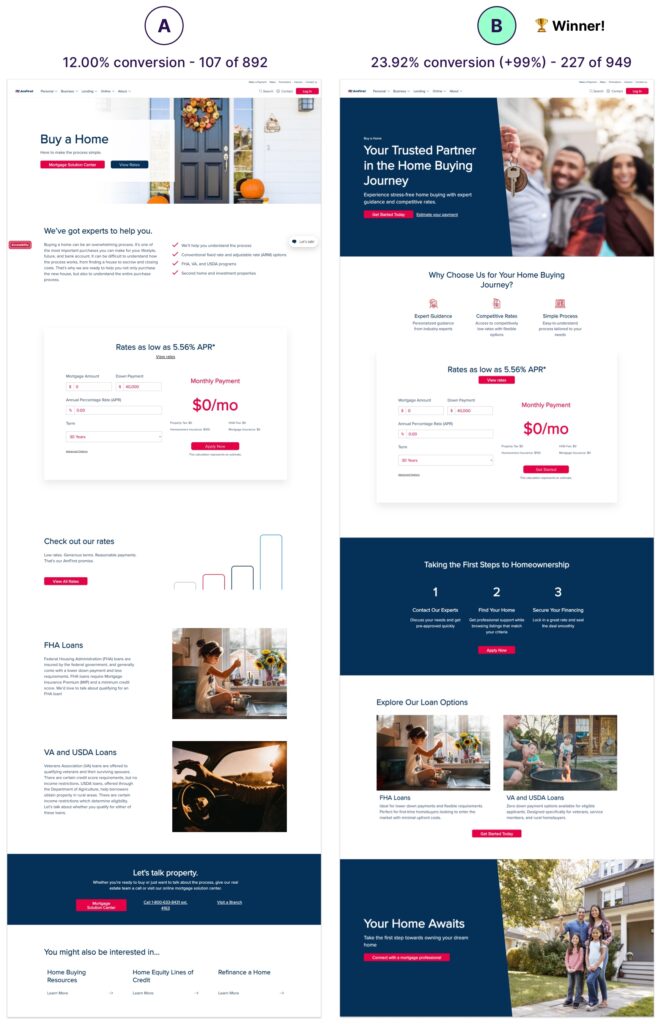
This kind of improvement isn’t based on guesswork. It’s driven by conversion optimization and A/B testing.
Whether you are thinking about a website redesign or not, AI-compatibility and conversion optimization ought to be included in your 2026 budget.
Take these steps (use the free tools mentioned below):
- Start monitoring your AI visibility and doing Generative Engine Optimization (GEO).
- Test your site's AI experience (AIX) using ChatGPT's agent mode. For example, can the AI complete lead capture forms and schedule appointments?
- Set up your website's conversion funnels, benchmark them with other credit unions, and start A/B testing to increase conversions.
These aren’t extras—they’re essentials for the present and future.
Here are two free tools that can help you with GEO and conversion optimization:
- 👁️Free tool for GEO: Get a free AI visibility report from MetriFi to see if AI is mentioning your credit union. It only takes a couple minutes and could be one the most important analytics reports you get this year.
- 📊Free tool for conversion optimization: Use MetriFi’s Opportunity Intelligence to track your conversion funnels, benchmark them with other credit unions, and uncover how much in loans and deposits your site is leaving on the table. Then, MetriFi AI will even generate higher converting prototypes for you.
The internet is changing fast. Credit unions that embrace AI visibility and data-backed optimization have an opportunity to not only survive the shift, but lead it.
Email me at dk@metrifi.com and I’ll help you get started.