

The credit card business has always been complex. Elan recently partnered with Tim Kolk, President of TRK Advisors, for an informative webinar that dove into the current state of the credit card market and, specifically, how credit unions are performing compared to bank issuers. Three themes stood out for financial institutions looking to maintain or build a scalable credit card program.
First, there are no shortcuts to winning in credit cards.
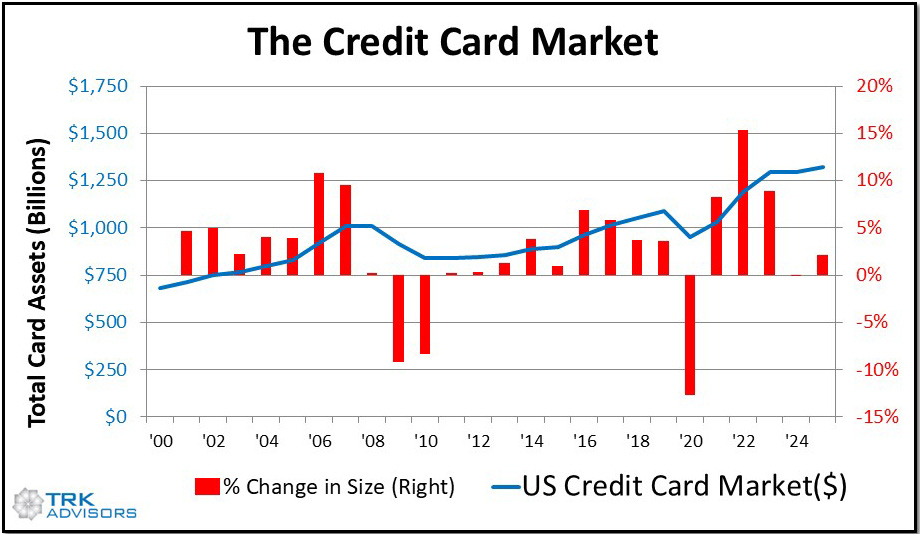
The market itself grows steadily, not explosively. Financial institutions that succeed do so by consistently executing the fundamentals: adding accounts, activating them, increasing spend and balances, and managing credit quality over time.
While there are ups and downs, the U.S. credit card market has been growing steadily since 2000. Growth is not the result of one campaign or pricing move—it is the cumulative outcome of many small, coordinated decisions made year after year. When momentum slows, catching back up becomes harder. Credit cards reward patience and persistence.
Second, traditional credit union advantages are under pressure.
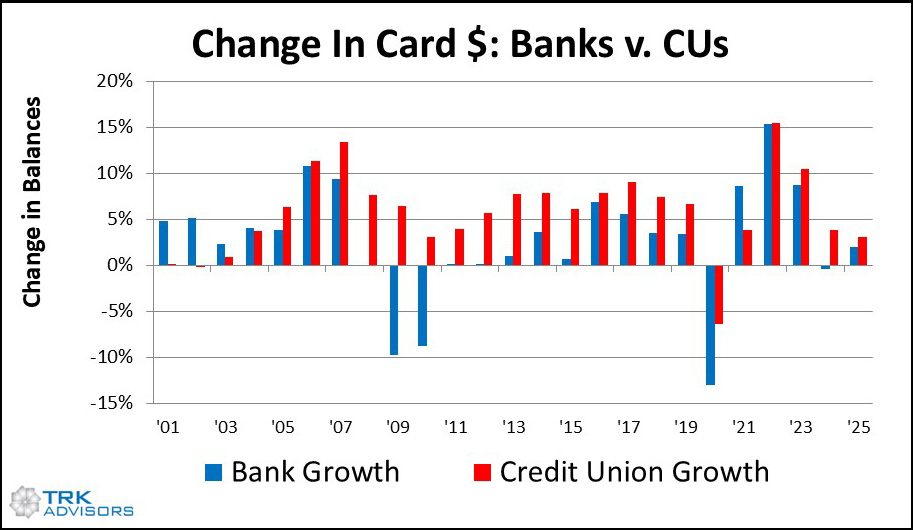
For years, lower charge-offs and member loyalty created meaningful differentiation. Today, those advantages are narrowing as credit unions and banks increasingly compete in the same middle-market segments. In the first part of the century, credit unions grew their portfolios at higher rates than banks. However, in the last five years the growth rates have narrowed.
Rewards expectations are higher, consumers are saturated, and pricing pressure is real. In this environment, trying to outspend or out-feature larger issuers is rarely sustainable. Instead, success depends on intentional choices like where to compete, which segments matter most, and how to align product design and resources with realistic returns.
Third, performance insight is no longer optional.
Some institutions stumble into early success without deep analytics, but scaling without them is unlikely. Credit cards are a mature operating business, and they demand product-level profitability, growth, and risk visibility. Without clear insight into what drives results, consistency breaks down, decisions turn reactive, and excellence becomes impossible to sustain.
Ultimately, the institutions that win in credit cards will be the ones that treat it not as a side product, but as a disciplined, always-on business.
For a deeper look, download the full analysis or watch the webinar replay here.