The credit union was not invented to be a friendlier bank. It was invented to defeat the loan shark. When famine swept the Rhineland in the late 1840s, the small farmers who fed everyone else fell into the grip of the moneylenders, and a young mayor named Friedrich Wilhelm Raiffeisen saw that charity treats the symptom while leaving the disease—and the disease was usury, the extractive grip of centralized lenders on the very people producing the community's real wealth. So in 1864 he built something more durable than a bread line: neighbors pooling their own resources, governing the thing themselves, lending to one another on fair terms—self-help, self-governance, self-responsibility. Two generations and an ocean later, Edward Filene—the Boston magnate whose name still hangs over the bargain 'Basement' he invented—brought the idea home, and with Massachusetts' banking commissioner wrote the first American credit union law in 1909. When they named it, they reached for two words on purpose: 'credit,' to plant a flag against the loan shark, and 'union,' to stand with working people. Franklin Roosevelt signed the Federal Credit Union Act in 1934, and the movement took root in every town in America. The charter beneath all of it was a deliberate alternative—local instead of hyper-centralized, member-governed instead of shareholder-extracted, cooperative instead of usurious.
I rehearse this not for nostalgia, but because the founding question—Will ordinary people govern their own access to capital, or rent it back, at a markup, from those whose business is extraction?—has come all the way back around.
Here's why. The dollars in your members' accounts have been electronic for decades—ledger entries inside a handful of correspondent banks. What is changing is not whether money is digital, but the substrate it settles on. Money is doing what music, mail, and media did before it: transcending the physical and becoming a streaming, programmable, networked thing that moves across open rails. That migration is not a forecast on a conference slide; it is happening on a schedule, with launch dates. The electronic dollar—the closed ledger entry that has been the final word in settlement for your whole career—will not be the final word much longer.
Now recall the quiet victory lap a good many community banking leaders allowed themselves when the dreaded central bank digital currency—the surveillance dollar, the programmable leash—got run out of Washington. The House said no. The trade groups cheered. The threat, we told ourselves, was handled. I'd gently suggest we celebrated the wrong thing, because killing the public version of programmable money did not kill programmable money. It cleared the field for a private one (stablecoins/tokenized deposits). While we admired the trophy, the largest bank in the country went live with a tokenized deposit on a public blockchain. Citi stood up its own token services. And JPMorgan, Bank of America, Wells, and Citi—the same four names, every time—began building a shared tokenized-deposit network through The Clearing House, the payments utility they conveniently happen to own, with a separate consortium already aiming a retail version squarely at your members. We did not avoid a programmable digital dollar. We handed the press for it to the four institutions with the biggest balance sheets and the best-paid lobbyists, and we called it a win (and branded it 'stablecoin' and 'tokenized deposits').
So here is the fork—a real one, with no comfortable third road. Down the first path, your institution becomes a gateway. The digital dollar of the near future is a deposit token issued upstream, by someone far larger than you. You don't issue it, you don't custody the network, you don't govern its rules—you resell it. You become the friendly local storefront, the compliance-bearing last mile, a cheap retail franchisee of a programmable, usurious, privacy-destroying, wealth-vaporizing bank dollar. And make no mistake about that word 'usurious,' because it is the whole point: a programmable dollar is one whose issuer writes the rules of what it can do, where it can travel, who may hold it, and on what terms it may be lent or spent. That is not the end of usury. That is usury rebuilt at the protocol layer—the loan shark Raiffeisen and Filene set out to defeat, resurrected with a software update and a monopoly on the rails. To volunteer your charter for that role is not strategy; it is surrender dressed up as a vendor agreement.
Down the second path, you plug in directly—and you fulfill the charter rather than abandon it. Community and regional institutions connect natively to open, permissionless settlement networks—Bitcoin, Ethereum, USDC, and whatever succeeds them—as first-class participants, not resellers renting space inside someone else's walled garden. You custody. You intermediate. You govern locally. And the cooperative charter stops being an analog relic to be disintermediated and becomes the trust layer for an entire on-chain economy. These are not foreign values you'd have to import: decentralized power, local control, personal storage, sound stewardship of wealth, democratic governance of capital—those principles are coded into Bitcoin's network, and they have been coded into your institution's DNA since a Rhineland winter in 1864. I'm often asked by boards, "why is Bitcoin worth anything?" I've taken to answering with a question of my own: why is the credit union movement worth anything? Answer the second honestly and you will have answered the first.
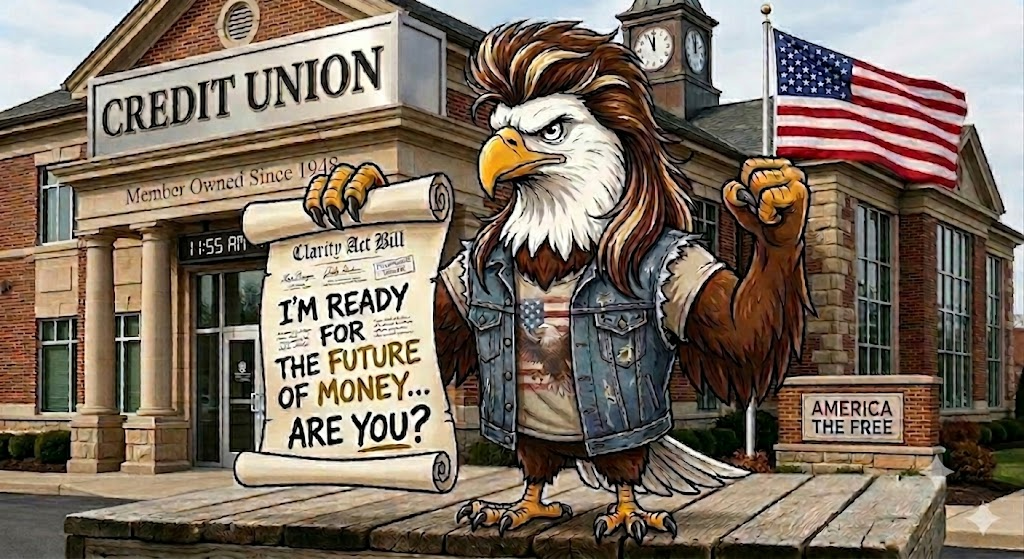
Which brings me to the uncomfortable part. The CLARITY Act is the bill that would give institutions other than the money-center banks a clean, legal path to touch digital-commodity markets and reach these open networks directly. It cleared the House. It has stalled—more than once—in the Senate, where the friction keeps clustering, suspiciously, around the very provisions that matter most to the little guy: yield, access to decentralized rails, the right to self-custody. The clauses, in other words, that would let a community institution go around the walled garden instead of paying rent inside it. You needn't believe in a smoke-filled room to read the pattern. The same titans tell their analysts that market-structure clarity would be a fine thing, while their trade associations spend their energy fighting the specific provisions that would let you compete—all while they ship their own private deposit-token rails, on schedule. So watch what they build, not what they say. A rational giant defends its moat; that isn't villainy, it's strategy. But the consequence for you is identical either way: every month CLARITY sits parked on the calendar is another month the consortium rails harden and your direct-access door narrows.
Which is exactly why 'neutral' is not a chair available to you. The big banks are not neutral; they are building product and shaping legislation at the same time, today, with intent. In a contest between a side that is building-and-lobbying and a side that is 'staying out of politics,' there is no tie—abstention is simply a vote for the first future, cast on your behalf, by your largest competitor, while you weren't looking.
Now, more than at any point in our history, the leaders of America's credit unions must answer or abandon the noble charter of the Credit Union Act. Either we act—deliberately, vocally, now—to preserve local, decentralized, democratic finance as a living alternative to hyper-centralized, for-profit usury; or we submit ourselves as cheap franchisees of a programmable bank dollar and quietly hand back the very thing Raiffeisen and Filene fought to give ordinary people. The last line of defense for locally stored, democratically governed, cooperatively processed capital is the same line it has always been: you. It will not hold by default. But it can hold. The choice, as ever, is yours to make.
A final word, lest any of this read as mere manifesto. It isn't one. DaLand CUSO is a credit-union-owned cooperative, and we did not write these warnings without also building the means to answer them. Coin2Core and the cooperative fintech we've built around it are already in production, plugging community institutions directly into the open networks described above while keeping deposits, data, governance, and the member relationship local, sovereign, and democratically owned. Consider this piece the manifesto, and what we've built the battle plan and the armory—the tools for the institutions willing to actually hold the line. The manifesto is the easy part; the weapons are already forged. Come find them, and us, at www.dalandcuso.com.