
The pressure on credit union leaders to “solve for AI” has moved past a gentle nudge into a full-scale shove. Boardroom conversations are dominated by speed and efficiency.
But as we navigate this Still Human era, the most important question isn’t how fast we deploy the technology—it’s how much thinking we’ve done about the humans on either side of the screen.
To lead effectively, we must look past the code and address the human factors that determine whether AI becomes a bridge—or a barrier.
1. The FOMO syndrome: Speed vs. substance
A pervasive Fear Of Missing Out (FOMO) is driving implementation cycles. We see fintechs moving at light speed and feel an urgent need to keep up.
That pressure often leads to Shiny Object Syndrome—adopting tools before the problem they’re meant to solve is even clearly defined.
Authentic leadership requires the courage to slow down.
Being first matters far less than being right for your members. Credit union leaders have always put people first. As more financial institutions adopt AI, particularly in customer and member experience, your human-centric approach is not outdated. It is your competitive advantage.
Before signing the next vendor contract, ask a simple question:
Is this solving a member’s frustration—or just quieting our own anxiety about being left behind?
2. The ROI reality check
Early AI marketing promised massive, immediate returns.
Now we’re starting to see something different: ROI disappointment.
Organizations are discovering the hidden costs—data cleanup, governance, compliance oversight, and extensive staff retraining. These often dilute or delay the efficiency gains everyone expected.
For credit unions, where capital is a sacred trust, that matters.
If the ROI doesn’t appear in the efficiency ratio, it must show up somewhere else—in Human ROI.
If the technology isn’t helping members feel more seen, or helping employees feel more capable and empowered, it’s not an innovation.
It’s a distraction.
Forward-looking organizations are making a significant shift. There is a growing movement to re-skill rather than replace human employees. Rather than replacing employees with AI agents, many organizations are seeing exponential value when a single employee can manage multiple AI tools to better serve their organization and their public.
3. Your relationship with the machine
AI implementation isn’t just a technical decision.
It’s a relational one.
Every leadership team must answer a fundamental question:
Is AI a replacement for human judgment—or an assistant to it?
That decision shapes your culture.
If your team sees AI as a threat to their relevance, performance and morale will suffer. But if it’s positioned as a tool that handles the robotic parts of the job—freeing people to be the warm, accessible advisors your members trust—the technology changes character.
AI should make us more human, not less.
4. The leadership vacuum
The most significant long-term risk of AI may be something we’re barely discussing yet: a growing leadership vacuum.
Historically, entry-level roles in branches and call centers have served as the proving grounds for future leaders. This is where people learn the nuances of service, empathy, and real-world problem solving.
If we automate those first rungs of the career ladder, we risk cutting off our leadership pipeline.
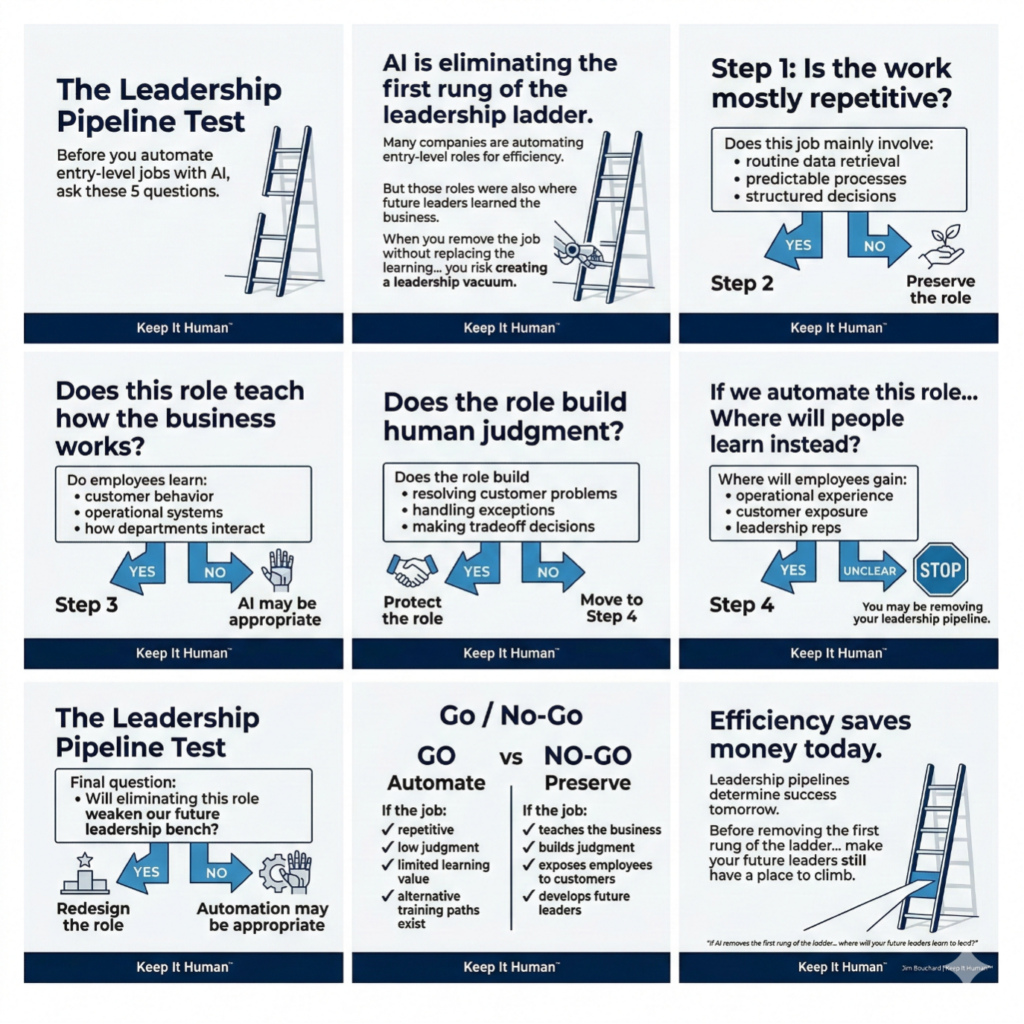
If AI handles the “easy” tasks, leaders must become far more intentional about mentoring the next generation to handle the hard, human ones.
Efficiency is important—but not at the expense of the people who will lead our organizations tomorrow.
The bottom line
Credit unions were built on a simple idea: people helping people.
In a world increasingly shaped by algorithms and automation, our true competitive advantage isn’t technology.
It’s leadership.
The question isn’t whether credit unions will adopt AI.
They will.
The real question is whether we will use it to build smarter machines—or more thoughtful, human-centric organizations.
The AI conversation is accelerating. But leadership has always been about people.
The organizations that thrive won’t be the ones that move the fastest—they’ll be the ones that think the deepest.