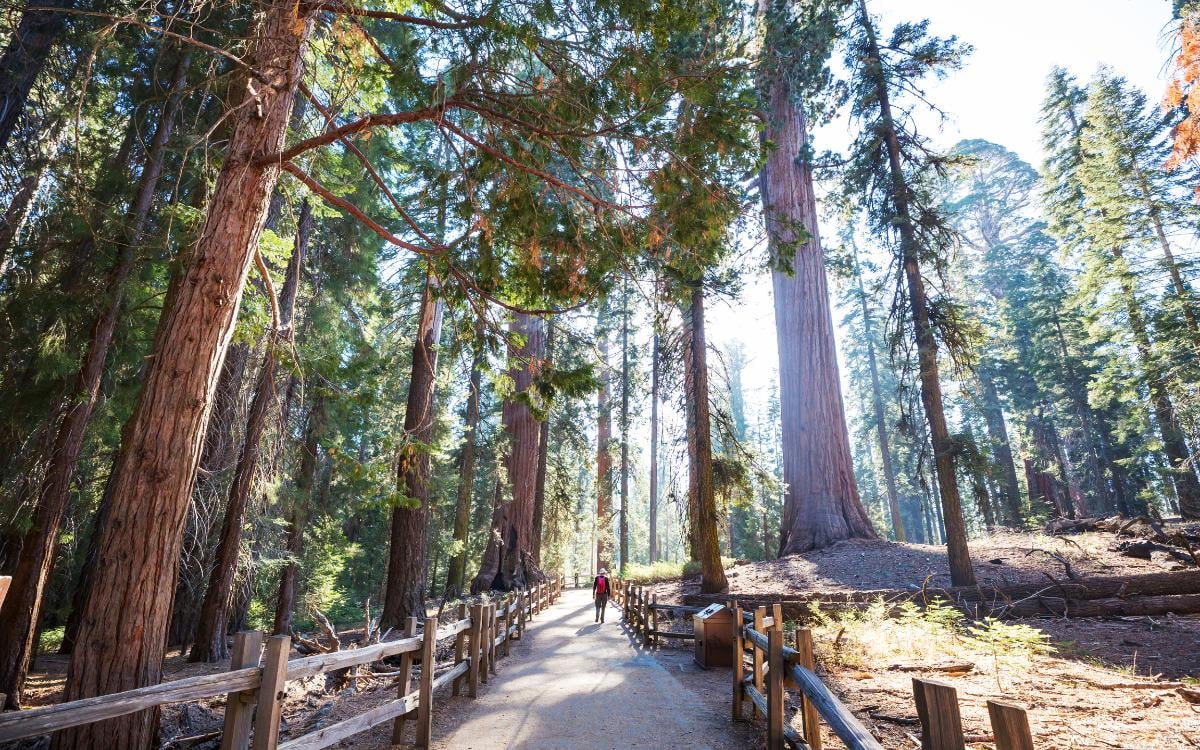
This past summer, I stood beneath the immense canopy of Sequoia National Park while a park ranger told the story of how these trees, and this place, came to be protected. The giant sequoias rose like monuments, some more than 300 feet tall, their trunks wider than city streets. These were not just trees; they were survivors—older than nations, older than institutions we consider permanent.
Yet the ranger disrupted the awe with a quiet truth.
“They look invincible,” he said, “but they’re not. These giants only survive if the forest survives.”
That truth is why Sequoia National Park exists at all.
When giant sequoias were first encountered by settlers in the mid-1800s, they were treated as curiosities or commodities. Trees that had taken thousands of years to grow were cut down in minutes. One was felled so its stump could become a dance floor. Another was stripped of bark and shipped east as proof of existence.
John Muir watched this destruction unfold and warned:
“God has cared for these trees, saved them from drought, disease, avalanches, and a thousand storms and floods; but He cannot save them from fools.”
Protection came only when we recognized that without regeneration, and without the forest itself, even giants disappear.
A forest, not a skyline
Our credit union system increasingly measures success by size. We celebrate billion-dollar institutions, national reach, and operational sophistication. Large credit unions are essential. They are strong, resilient, and influential—the giant sequoias of our movement.
But forests are not skylines.
A forest survives because it contains layers: giants, mature trees, young trees, saplings and, critically, a shared root system beneath the surface.
Sequoias offer a powerful lesson here. Despite their massive height, their roots do not plunge deep into the earth. Instead, they spread wide and interlock with the roots of neighboring trees. Their strength does not come from depth—it comes from connection.
No single sequoia stands alone. Each one is stabilized by the roots of others.
Small credit unions: The living understory and root network
Small credit unions are both the understory and a critical part of the root system of our movement.
They anchor communities. They stabilize the system during economic shifts. They provide redundancy, diversity, and resilience. Their local governance structures keep decision-making close to members. Their leaders are often deeply embedded in the lives of the people they serve.
Small credit unions do what many large institutions often cannot:
- They maintain trust through proximity.
- They serve narrow or emerging fields of membership.
- They cultivate volunteer leadership.
- They experiment organically.
Just as roots share nutrients and strength across the forest floor, small credit unions quietly support the broader system: training leaders, piloting ideas, and maintaining credibility at the community level.
Remove the root network, and even the tallest trees become vulnerable.
The alarming loss of our roots
Today, we are losing more than 140 credit unions each year, primarily through mergers. The vast majority of these are small credit unions.
At the same time, we are chartering only two to four de novo credit unions annually.
This is not natural thinning.
This is systemic erosion.
In forestry, the loss of interconnected roots leads to soil instability, increased disease, and collapse during storms. In our industry, the loss of small credit unions weakens leadership pipelines, reduces innovation, and distances the movement from its cooperative purpose.
Mergers may redistribute assets, but they sever roots.
De novo credit unions: New roots taking hold
De novo credit unions are the seeds that become new roots.
They emerge where existing institutions cannot reach or no longer reach effectively. They reflect new economic realities: gig workers, new immigrant communities, digital cooperatives, and emerging industries.
Roy Bergengren (attributed) reminded us:
“Credit unions are organized because people need them.”
Needs do not disappear simply because we stop planting. They go unmet or they are met elsewhere.
Without de novos, the root system stops expanding. And a forest that stops expanding its roots eventually loses its ability to hold.
Interconnected roots: Muir, Filene, and the cooperative system
Standing in that forest, the ranger explained that when one sequoia is damaged, surrounding trees often weaken, not because they are physically touched, but because their shared roots are disrupted.
John Muir understood this interdependence:
“When we try to pick out anything by itself, we find it hitched to everything else in the universe.”
Edward A. Filene understood the same truth within the cooperative system. He did not see credit unions as isolated entities, but as a shared cause, bound together by mutual reliance.
Causes require connection. Systems require roots.
When small credit unions fail or disappear, the impact is not isolated. It reverberates through the system—weakening shared advocacy, diminishing cooperative identity, and reducing resilience for all.
An aging, shallow-rooted forest is a risky one
A forest dominated only by giants, with few young trees and a shrinking root network, is impressive but unstable. Wind, fire, or disease can topple even the largest trees when their roots no longer intertwine.
The same risk exists for our movement.
Small credit unions provide:
- Structural stability
- Leadership development
- Cultural continuity
- Local legitimacy
Small credit unions keep us grounded—literally and figuratively.
The stewardship responsibility of the giants
Today’s Sequoia forests are actively managed. Fire is allowed because regeneration and root expansion depend on it. The goal is not to freeze the forest but to sustain it.
Large credit unions have the same stewardship responsibility.
Credit union reforestation means:
- Strengthening the shared root system through collaboration
- Supporting small credit unions with shared services and technology
- Investing in de novo charters
- Developing leaders across institutions of all sizes
- Advocating for proportional regulation
This is not charity.
It is ecosystem preservation.
Planting for the next century
Sequoia National Park exists because someone recognized that protecting the giants requires protecting the entire forest, including the roots beneath the soil.
Our movement now faces the same choice.
Edward Filene reminded us: “Progress is not achieved by standing still.”
And John Muir warned us that nothing stands alone.
If we want a credit union system that still matters 100 years from now, we must protect the giants, nurture the understory, strengthen the roots, and intentionally plant new seeds.
Because without small credit unions…
without de novo credit unions…
without interconnected roots…
Even the mightiest giants will eventually fall.
And the forest we were entrusted to steward will be gone.