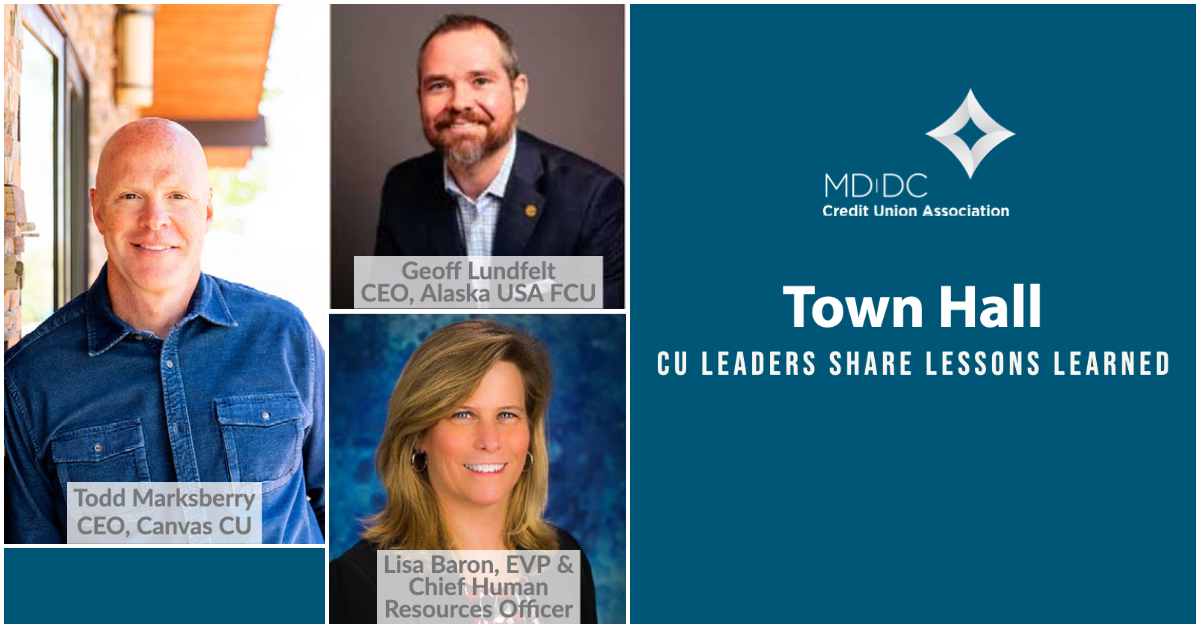
The pandemic has changed virtually everything we do, from how we work to how we conduct business. To gain insight on lessons learned, the MD|DC Credit Union Association hosted a Town Hall on September 30, bringing together credit union leaders from across the country to discuss how their organizations pivoted quickly to respond to the crisis and how disruption is driving change.
MD|DC CUA President/CEO John Bratsakis served as moderator and panelists included: Geoff Lundfelt, CEO of Alaska USA FCU; Todd Marksberry, CEO of Canvas Credit Union; and Lisa Baron, EVP and Chief Human Resources Officer for BCU.
While every panelist said they had existing business continuity and emergency response plans in place, no one had a playbook for a crisis of this magnitude. Credit unions moved quickly to close branches and find other ways to serve members. Calling it a “Herculean” event for the IT department, Baron said 95% of BCU’s 650 employees shifted to remote work in a matter of weeks. Panelists said they reassigned many of the employees who worked in branches to departments in need of assistance.
Lundfelt said Alaska USA FCU was sensitive to employee perception. “We found ways to utilize their skill sets in other areas – call centers, mortgage, and consumer loan originations to keep them working. We were careful not to ever classify employees as anything but essential, even if their job function wasn’t necessarily as critical as another. We didn’t want employees feeling like their job wasn’t important.”
Communication is Key
All panelists agreed that effective communication continues to be critically important to keeping staff engaged and for preserving the workplace culture. According to Lundfelt, “The key is communications whatever your culture is within your organization, you want to maintain that and continue to figure out a way to build on that unique culture and you have to be able to connect with employees even when they’re at home.”
The CEO of BCU keeps connected by personally calling 6 to 8 employees every day to see how they are doing. The credit union also conducts weekly pulse surveys to identify in real time what issues staff may be dealing with. Baron explained why BCU has continued its relentless focus on workplace culture, “It takes a while to develop a culture, but it can take a day or week to ruin it. You have to recognize the consistency around the focus on workplace culture.”
Employees First
Marksberry said Canvas Credit Union’s approach is to put employees first, and let members reap the benefits. “I always say to our folks I love our 260,000 members, but I love our 625 canvas family members more and I want you guys to know that we love you and care about you, and we want you to be safe and healthy. This has translated into employees serving our members in amazing ways.”
All three panelists said their credit unions offered additional time off for employees, along with unique programs to boost employee morale. Alaska USA FCU has given out Grubhub gift cards, hosted drive-in movies, and offers a monthly stipend to cover home internet service expenses. Canvas Credit Union sent staff Door Dash gift cards and has been streaming comedians and local bands during virtual employee gatherings. BCU is hosting an Employee Appreciation Day on October 12 to give everyone a chance to unplug and get a break from work for one day.
Disruption Driving Change
Panelists said the pandemic has provided the opportunity to lean in and make fundamental changes in how their credit unions operate. Recognizing that members have been experiencing tough times, Canvas Credit Union began reaching out to members by phone to simply check on them – no sales pitch. Marksberry said members have responded positively and the plan is to continue making those calls beyond the pandemic. “We are going to make it a huge part of who we are as a credit union.”
Baron said the move to remote work has led BCU to realize it can hire from a much wider talent pool. “You might imagine being close to Chicago, it’s a higher cost of living area. How can we hire folks from around the country where there’s great talent and where it may be a lower cost of living? Now we can not only leverage the talent side, but also the cost side. Those are two things we had not imagined in the past.”
If there’s a silver lining to the disruption caused by the pandemic, Marksberry said it’s that “There has been more collaboration, old school credit union collaboration than I’ve seen in probably 10 years. And I think that’s one of the gifts of this time.”