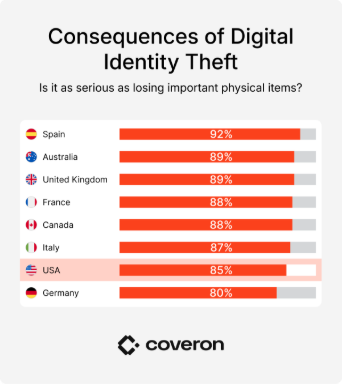
The intangible has become just as valuable as the tangible, if not more. A new survey carried out by Coveron across eight countries, including the United States, reveals that people now globally recognize digital identity theft as serious as losing your wallet, phone, or keys.
The results highlight a fundamental shift in how people understand modern security threats: lost digital credentials can upend your life just as much as a stolen wallet.
While agreement varies by country, the recognition is nearly universal, with Spain showing the highest consensus at 92%, United States at 85%, and Germany the most skeptical at 80%. Notably, only 1-4% across all countries actively disagreed with the premise. Most people either recognize the threat or remain uncertain.
"We've crossed a threshold where people are starting to understand that their digital identity is as real and vulnerable as what's in their pocket," says Tomas Sinicki, managing director at Coveron. "Americans are also aware of this risk, and the data shows exactly what anxieties they face."
The identity theft concerns map
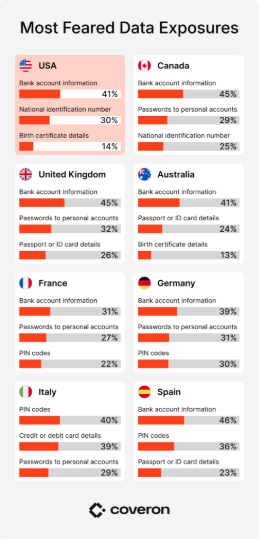
The survey investigated which specific types of data people would be most worried about seeing exposed online. Bank account information topped the list across all eight countries, but the other most-feared data types reveal stark differences shaped by each nation's institutional infrastructure and digital security culture.
A closer look at each country's top concerns reveals distinct patterns:
- United States: The country stands alone with national identification numbers ranking as the third-highest concern at 30%, significantly higher than any other country. This reflects the outsized role Social Security numbers play in American identity infrastructure and decades of SSN-based identity theft.
- Italy: The only country where PIN codes (40%) actually surpass bank account information (29%) as the top concern, highlighting an inversion of the overall pattern. Spain shows similarly elevated PIN anxiety at 36%, suggesting these Mediterranean countries are focused on transaction-level security.
- France and Germany: Both Continental European countries rank passwords to personal accounts in their top three concerns, with Germany at 31% (#2) and France at 27% (#3). This reveals a shared emphasis on protecting digital access credentials.
- United Kingdom: The UK shows elevated concern for both passwords (32%) and passports (26%), making it the only country where digital credentials and physical identity documents both appear among the most prominent categories, bridging two distinct security anxieties. Australia shares heightened passport anxiety at 24%, and further emphasizes physical identity documents with birth certificate details (13%), suggesting particular vulnerability around foundational, government-issued credentials that anchor official identity.
- Canada: Canadians show equal concern for passwords to personal accounts and PIN codes (both 29%), alongside national identification numbers (25%). This reflects a balanced emphasis on protecting digital access credentials and government-issued identifiers, bridging the gap between transaction security and institutional identity.
How to protect yourself
Understanding the threat is only the first step. Tomas Sinicki shares practical advice for protecting your identity:
- Verify before you trust. Legitimate institutions will never call you unexpectedly demanding sensitive information. If you receive such a call, hang up and contact the institution directly using a verified number from their official website.
- Never share sensitive data over unsolicited calls. This includes Social Security numbers, bank account details, passwords, or passport information. No legitimate institution requests this information over the phone.
- Be especially skeptical of authority. The survey shows that bank and police impersonation work precisely because people are conditioned to comply when these entities make contact. Pause, verify, and question any unexpected call claiming to represent an institution.
- Watch for country-specific scams. Americans should be particularly alert to Social Security Administration impersonation, while those in Commonwealth nations should verify any calls regarding passport or government document verification.
- Use comprehensive identity protection. Services like Coveron, which provide monitoring, security alerts, and expert support to help detect threats before they result in financial or reputational damage, can be crucial.
Methodology
The survey was conducted from March 26–April 6, 2026. A total of 7,862 residents aged 18–74 were surveyed across eight countries: Australia, Canada, France, Germany, Italy, Spain, the United Kingdom, and the United States. Quotas were placed on age, gender, and place of residence to ensure a nationally representative sample of internet users in each market. Fieldwork was carried out by Cint, a global technology company that operates an online marketplace for digital market research.