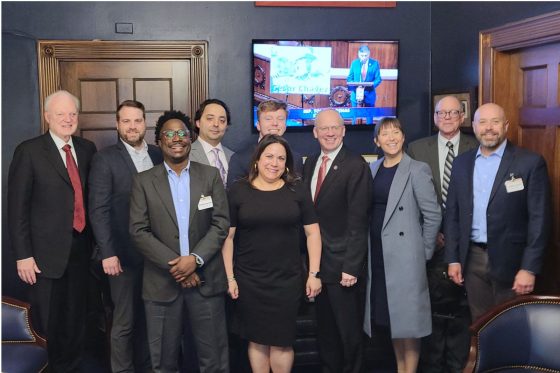
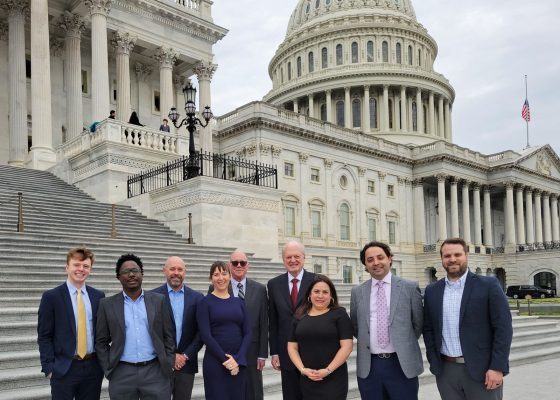
After a long delay due to the COVID-19 pandemic, ATMIA USA hosted its first Fly-in event since 2019. Member participants included Ayman Rida from cash2bitcoin.com; Cooper Frandsen representing NextATM; Jason Ross from GMR; Maya Fuentes representing Paramount Management Group; and Tony Mercer with ATM USA.
ATMIA USA Executive Director, David Tente, organized and led the group. GRC co-chair John Hagy, Chief Policy Officer for MetaBank, arranged for the group’s meetings, along with assistance from Chas Thomas of Thorn Run Partners. Elizabeth Gorz, VP, Public Policy for MetaBank led the discussions with members and staff, assisted by Hayden Cole.
The meeting with Representative John Rose of Tennessee was unquestionably the most productive of the day. David provided some background information on ATMIA and the ATM industry, explaining our unique position as a representative of all industry stakeholders. And noted that ATM deployers, both financial institutions and independents, do constitute the largest single segment of the association.
As a member of the House Financial Services Committee, David thanked Rep Rose for his support of the Payment Choice Act. He made mention of the fact that ATMIA had advocated at the state level for bans on cashless retail establishments several years prior to the federal initiative. Passage of that Act is one of ATMIA’s primary advocacy issues. Rep Rose hopes that there will be a vote on the House bill yet this year, but was uncertain of its prospects in the Senate.
Another key concern shared by both financial institution and independent ATM operators is the huge increase in crimes involving the theft of ATMs. Maya Fuentes explained that these are generally considered property crimes at the state level, as there is no federal crime for ATM burglary. She cited recent data indicating that the average loss in such incidents is over $50,000. But unlike bank robbery crimes, the perpetrators are quickly back out on the street repeating the same offense.
Maya called attention to a bill that Rep Carolyn Maloney is working on that would increase criminal penalties for ATM robbery. Rep Rose said that he has spoken with bankers in his own district who have expressed concern about such issues, and he would be happy to support it. Jason Ross added that there is still a stiff federal penalty for bank robbery, which may be causing some thieves to shift over to the less risky and more lucrative crime of ATM theft.
The surge in cryptocurrency ATMs and kiosks, David noted, is further testament to the all-inclusive nature of ATMIA’s membership and its ability to represent the entire industry. Ayman Rida informed Rep Rose of the current inconsistencies in regulation and compliance that exist at the state level. The early deployers went through stringent vetting processes with FinCEN and MSB regulators. Today, however, new entrants to the market are often not subject to the same requirements.
ATMIA understands that further regulation of the crypto segment is inevitable. However, the association requests that such regulation be reasonable and rest within one primary agency. The infrastructure bill passed last year, for example, is already adding to potential confusion, by amending the definition of “cash” to include digital assets. At the federal level, the SEC, CFTC, OFAC, and FinCEN all have asserted enforcement authority over various, sometimes overlapping sectors of the cryptocurrency industry. That sort of patchwork would not be healthy for the industry or its consumers.
Rep Rose also asked for our thoughts on prospects for a CBDC (central bank digital currency) – i.e. the digital dollar. David commented that it would not be the panacea for financial inclusion that some think. Many of the unbanked and underbanked are so by choice, due to a lack of trust in the government or financial institutions.
Nevertheless, a U.S. CBDC is probably inevitable at some point.
David encouraged Rep Rose and his staff to reach out to ATMIA and its members at any time for input on these and other issues.
John Hagy led the discussion with Lucas West, Sr Policy Advisor for Rep Blaine Luetkemeyer that was focused on the efforts of Representatives Luetkemeyer, Rose, and Maloney on the bank closure issue. Lucas described the efforts of the three Members to obtain changes to the language in the BSA/AML exam manual – which were successful. However, the Members believe the agencies could have gone further in describing the level of risk for money laundering at ATMs.
Lucas made a point of describing the effort of the Members in questioning the analysis of the agencies that failed to recognize the relatively low risk of money laundering inherent with ATM businesses. In fact, they directly requested information about specific cases involving ATMs and money laundering. Lucas reported that no information was forthcoming. As a result, the Members have sent a follow-up letter to the Agencies requesting a policy statement, reflecting the low risk of the ATM industry. They are awaiting a response and will let us know about their progress.
Similar discussions were held with staff for Rep Cynthia Axne (Iowa), Sen Mike Rounds (South Dakota), and Sen Kevin Cramer (North Dakota). Rounds’ staff does expect the Payment Choice Act to be re-introduced in the Senate very shortly. They also expressed interest in supporting the Maloney bill.