
“The truth will set you free, but first it will make you miserable.”
Variations of this quote have existed for years, but this one, attributed to James Garfield, is especially relevant to change and transformation.
The “miserable” part is that you can upgrade your technology, redesign your branches, offer new products, improve your marketing, and still find yourself exhausted by the lack of progress.
Member expectations will continue to rise. Competitors will target your members. The war for talent will not slow down. Strategic plans will get bolder every year.
And yet there is a real danger that the things needed to make your credit union truly stand out will still be lacking. Engagement will stay flat, accountability will be inconsistent, and turnover will quietly drain your culture and payroll.
Traditional wisdom says double down on what has been done in the past. Offer a new perk, increase the fun, bring in a speaker on change, upgrade your technology . . . again, or try a new strategic planning model.
There is nothing inherently wrong with any of these. I, in fact, have made my living providing many of these services for years.
Which leads to another miserable part of the truth: We are not significantly better at change, transformation, engagement, or accountability than we were 30 years ago.
Why?
Because none of the expensive solutions matter if you have mediocre or inconsistent leadership.
The truth that sets you free
Exceptional leaders make everything that you need to do to transform your credit union easier.
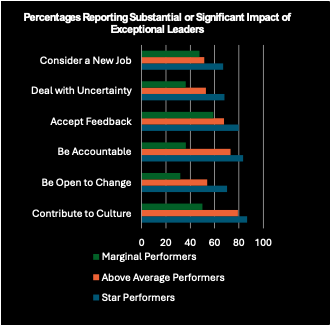
Results from the Whole Package Leadership™ research shows what many of us have suspected for years: leaders determine whether people stay, grow, or disengage.
Employees reporting to exceptional leaders are:
- Significantly more likely to be accountable;
- Far more willing to contribute to the culture;
- More open to change and coaching; and
- Less likely to consider leaving or even willing to take a call from a recruiter.
The impact is even greater with team members who self-identify as Star or Above Average performers.
The reverse is also true.
Mediocre leadership leads to the credit union version of organizational lethargy: apathy, turnover, and cultural decline.
You can’t build momentum on disengagement. And you can’t execute strategy if people don’t trust the person leading them.
Exceptional leaders are the sustainable advantage you can control.
The research is clear
Employees are not asking for superheroes. They are saying that they will go out of their way to exceed expectations for leaders who are The Whole Package—strong in every area of leadership performance.
Your team wants leaders who are solid at the fundamentals:
- Creating vision and thinking strategically
- Delivering results and empowering execution
- Communicating clearly to explain what, why, and what’s next
- Demonstrating Emotional Intelligence
- Understanding the business
- Making well-reasoned and timely decisions
They become even more engaged when their leaders:
- Create physical, mental, and emotional safety;
- Listen before deciding;
- Hold people accountable fairly and consistently; and
- Help them grow.
These expectations are the price of admission, however. Leaders move from solid and motivating to exceptional and memorable when they build on the basics with these three pillars.
1. Principled character
Engagement cannot be built on a foundation of suspicion. Followers respect and trust leaders who are consistent and congruent. The behavioral markers are:
- Doing what is right especially when it is inconvenient
- Keeping commitments
- Telling the truth even when the message is difficult
2. Authentic presence
Exceptional leaders show up. They are visible and available. They listen. They ask questions.
In the research, presence—not perfection or persona—was repeatedly cited as a top driver of loyalty and psychological safety.
3. People-centered performance
Memorable leaders have high standards and expect excellence. They just achieve extraordinary results through and with people not over them. Their road to success isn’t littered with the bodies of those that were run over or discarded.
The best leaders refuse to choose between empathy and accountability.
They care personally. They coach toward excellence. In return, followers respond by achieving more than they thought possible.
Whole Package™ Leadership synthesizes the best of past leadership models into a modern, practical framework that is right for the times. Think of it as an antidote to cultural lethargy.
One respondent summed it up this way: “They make you feel like your effort matters and your work is meaningful.”
Why this matters now
The credit union movement is built on purpose. On the other hand, purpose without leadership becomes nostalgia.
More options exist for members and staff. Mediocrity has faster consequences.
The next five years will belong to credit unions that build exceptional leaders rather than managers who are subject matter specialists. These leaders will be:
- Caring;
- Consistently present;
- Authentic and human;
- Growth-oriented; and
- Able to build strong cultures, not just strong teams.
What to do next
The good news is that the actions you need to take to move your credit union forward are not new.
- Stop assuming people know how to lead. Train and coach them. Hoping for common sense or personal epiphany is not a development strategy.
- Hire and promote for culture, not just competence. One person who “doesn’t get it” is all it takes to erode momentum
- Develop leaders who can influence change. All leadership is change leadership.
- Model what you want. Leaders eat last, but they go first.
Simple, huh? Those four action steps could appear at the end of any article on leadership, change, culture, and growth. The difference isn’t the steps. It is the focus.
Everything you want for your credit union sits on the other side of exceptional leadership.
If you want a stronger culture, grow exceptional leaders.
If you want better retention, grow exceptional leaders.
If you want accountability, innovation, and service excellence, grow exceptional leaders.
If we want things to be better, they must be different. If we want them to be different, they must change. It begins with building and nurturing exceptional leaders. It ends with a stronger, more resilient credit union.